
Corn jumps 4.9 % while gasoline slides 7.8 % on 2026‑08‑18
Corn rose to US$487.75, its highest level of the year, as sugar and US natural gas also gained. Gasoline, coffee and heating oil fell, while the euro edged higher against the dollar.
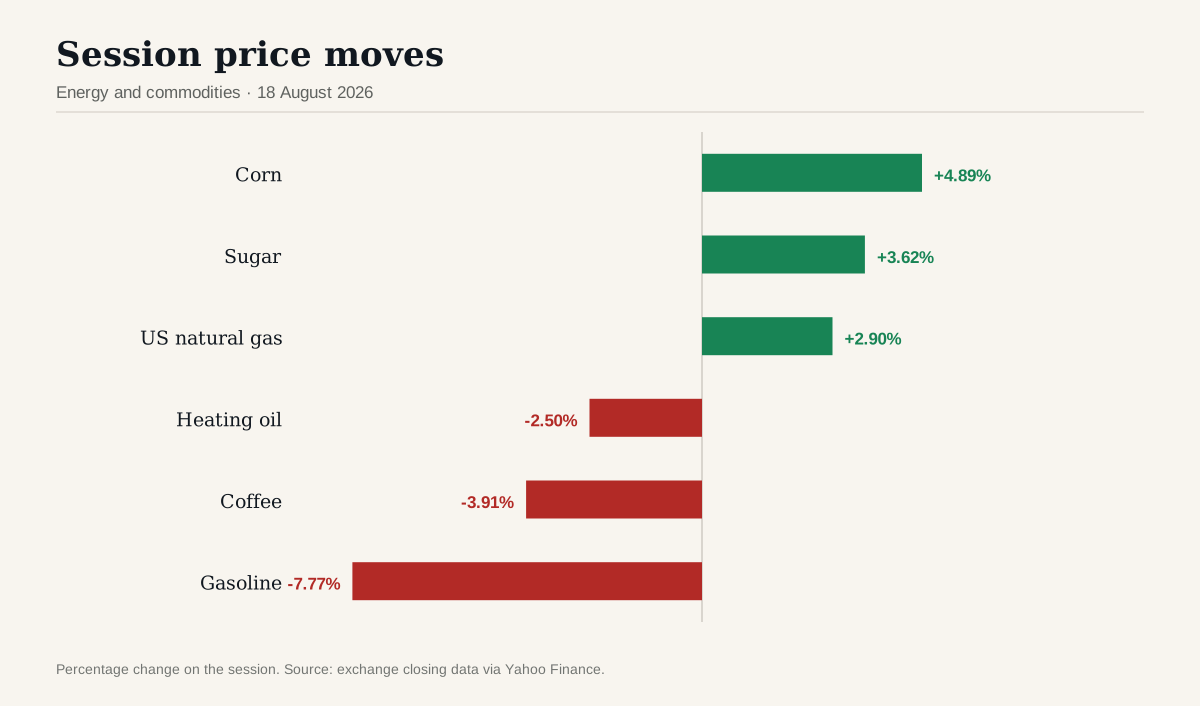
On 18 August 2026 the corn contract closed at US$487.75, up 4.89 % on the day and 11.68 % over the past five days. The move was the strongest among the twenty energy and commodity contracts that traded, with fourteen contracts gaining and six losing.
- Euro versus US dollar: 1.1582, up 0.07 % on the day
- Corn: US$487.75, up 4.89 % on the day
- Gasoline: US$3.016, down 7.77 % on the day
- US natural gas: US$2.768, up 2.90 % on the day
- Sugar: US$17.48, up 3.62 % on the day
Energy contracts
| Instrument | Close | Day | 5-day | Volume vs avg |
|---|---|---|---|---|
| Corn USX | 487.75 | +4.89% | +11.68% | 1.36x |
| Sugar USX | 17.48 | +3.62% | +4.48% | 1.79x |
| US natural gas USD | 2.77 | +2.90% | +0.04% | 0.98x |
| Heating oil USD | 4.33 | -2.50% | +1.73% | 0.71x |
| Coffee USX | 331.6 | -3.91% | -1.24% | 1.59x |
| Gasoline USD | 3.02 | -7.77% | -3.84% | 1.08x |
| Source: exchange closing data via Yahoo Finance, session of 2026-08-18. | ||||
US natural gas settled at US$2.768, a 2.90 % rise from the previous close of US$2.69. The five‑day change was marginal at +0.04 %, while the one‑month trend was down 3.22 %. Volume was 0.98 times the 20‑day average and the price sits 64.6 % below its 52‑week high of US$7.827. The price increase follows reports of cooler weather forecasts in the United States and a royalty trust announcing a monthly cash distribution, but no direct link is provided.
Gasoline fell to US$3.016, a 7.77 % decline from US$3.2701 the day before. The five‑day move was, 3.84 % and the one‑month slide, 11.01 %. Volume was 1.08 times the 20‑day average and the price remains 21.1 % below its 52‑week high of US$3.8232. The drop coincided with headlines about crude price movements linked to geopolitical developments, but the data do not specify a causal relationship.
Heating oil closed at US$4.3261, down 2.50 % from US$4.4371. Over the past five days the contract was up 1.73 % and over the month it was up 5.03 %. Volume was 0.71 times the 20‑day average and the price is 10.5 % below its 52‑week high of US$4.8353. The move occurred alongside reports on crude price fluctuations, yet the information supplied does not explain the price path.
Agricultural contracts
Corn surged to US$487.75, a 4.89 % gain on the day and an 8.51 % rise over the past month. Volume was 1.36 times the 20‑day average and the price is 1.1 % below its 52‑week high of US$493. The rally is described as a continuation of a Monday rally, with several reports noting USDA rating adjustments and a crop‑tour catalyst for corn and soybean markets.
Sugar advanced to US$17.48, up 3.62 % from US$16.87. The five‑day increase was 4.48 % and the one‑month gain 17.95 %. Volume was 1.79 times the 20‑day average and the price sits 0.6 % below its 52‑week high of US$17.59. The rise is linked to reports of a global sugar deficit that is supporting prices.
Coffee slipped to US$331.6, a 3.91 % decline from US$345.1. The five‑day change was, 1.24 % and the one‑month change, 0.84 %. Volume was 1.59 times the 20‑day average and the price remains 24.3 % below its 52‑week high of US$437.95. No specific news item is attached to the move.
Listed majors and utilities
The session saw fourteen of the twenty tracked companies post gains while six posted losses. No specific corporate announcements were attached to the price movements of the listed majors or utilities. Consequently, the data do not reveal whether any earnings releases, dividend decisions or strategic actions influenced the observed price changes.
Implications for European costs
European manufacturers that rely on corn as a feedstock or ingredient will face higher input costs. A 4.89 % rise in the corn price translates directly into a higher cost per tonne for food processors, livestock feed producers and bio‑fuel plants that source the commodity on the global market. The price is still close to its 52‑week peak, suggesting limited room for further upside without a new supply shock.
Food companies that use sugar will also see a cost increase. The 3.62 % rise pushes the price near its annual high, meaning that confectionery producers, beverage manufacturers and bakeries may experience tighter margins unless they can pass the higher cost to consumers.
European coffee roasters and retailers will benefit from the 3.91 % decline in coffee prices. The lower cost of green beans can improve margins for coffee chains and reduce retail prices, assuming the price pass‑through is not offset by other cost pressures.
For the industrial sector, the 2.90 % rise in US natural gas adds to the cost of electricity and heat where gas‑fired power plants are used. Chemical producers that rely on natural gas as a feedstock will see a modest increase in production costs. The euro's 0.07 % appreciation against the dollar slightly offsets the dollar‑denominated gas price for European buyers, but the effect is marginal compared with the price move itself.
The 7.77 % fall in gasoline reduces transport costs for logistics firms, delivery services and any business with a fleet of road vehicles. Lower gasoline prices can improve operating margins, especially for companies that have limited ability to hedge fuel costs.
Heating oil's 2.50 % decline eases the cost of heating for commercial buildings and for industries that use oil‑based heating systems. The modest volume of trading suggests limited liquidity, but the price move still offers a cost benefit.
Overall, the euro's slight gain against the dollar means that European importers of dollar‑priced commodities will pay marginally less in euro terms. The offset is small relative to the commodity price changes, but it does provide a modest cushion for firms that source multiple inputs in dollars.
Businesses that monitor commodity exposure will need to assess whether the current price levels justify hedging strategies. The mixed direction of moves, gains in corn, sugar and natural gas alongside falls in gasoline, coffee and heating oil, implies that a blanket hedging approach may be less effective than commodity‑specific risk management.
The next scheduled data release for the euro‑dollar pair is on 22 August 2026, when the European Central Bank is expected to publish its latest monetary policy decision. The outcome could influence the euro's exchange rate and, by extension, the euro cost of dollar‑denominated energy and agricultural inputs.