
Corn leads agricultural surge as gasoline slides 9 per cent in volatile session
CBOT corn futures jumped 7.5 per cent to within a fraction of their 52-week high while NYMEX gasoline tumbled 9.3 per cent, leaving European refiners and food processors facing sharply divergent input costs.
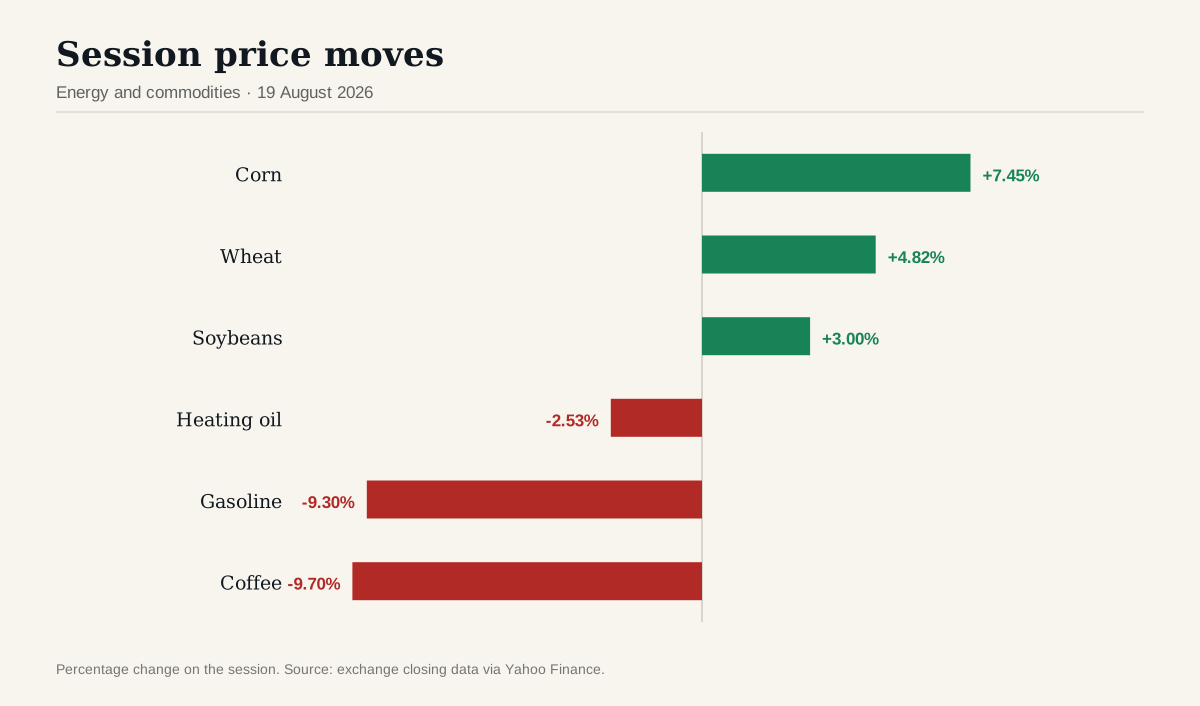
Corn futures on the Chicago Board of Trade closed at 497.75 US cents per bushel, up 7.45 per cent on the day and 8.92 per cent over five sessions, leaving the contract 0.1 per cent below its 52-week high of 498. Wheat added 4.82 per cent to 696.5 US cents, while soybeans rose 3.00 per cent to 1,236.75 US cents on volume 8.5 times the 20-day average. On the energy side, NYMEX gasoline fell 9.30 per cent to 2.9946 US dollars per gallon, its largest single-session drop in the data set, and heating oil slipped 2.53 per cent to 4.3375 US dollars. The euro strengthened 0.74 per cent to 1.1669 against the dollar, partially offsetting dollar-denominated commodity moves for European buyers.
- Corn (ZC=F): 497.75 US cents/bushel, +7.45% day, 0.1% below 52-week high
- Wheat (ZW=F): 696.5 US cents/bushel, +4.82% day, 2.1% below 52-week high
- Soybeans (ZS=F): 1,236.75 US cents/bushel, +3.00% day, volume 8.5x 20-day average
- Gasoline (RB=F): 2.9946 USD/gallon, -9.30% day, 21.7% below 52-week high
- Heating oil (HO=F): 4.3375 USD/gallon, -2.53% day, 10.3% below 52-week high
- EUR/USD: 1.1669, +0.74% day, 3.0% below 52-week high
Agricultural contracts surge on volume
| Instrument | Close | Day | 5-day | Volume vs avg |
|---|---|---|---|---|
| Corn USX | 497.75 | +7.45% | +8.92% | 1.76x |
| Wheat USX | 696.5 | +4.82% | +6.70% | 0.91x |
| Soybeans USX | 1,236.75 | +3.00% | +6.18% | 8.5x |
| Heating oil USD | 4.34 | -2.53% | +0.78% | 0.82x |
| Gasoline USD | 2.99 | -9.30% | -5.04% | 0.87x |
| Coffee USX | 328.15 | -9.70% | -3.51% | 1.5x |
| Source: exchange closing data via Yahoo Finance, session of 2026-08-19. | ||||
The grain and oilseed complex moved in concert, with corn leading the advance. The 7.45 per cent daily gain took the December contract to within 0.25 cents of its 52-week peak, a level last tested in the spring. Five-day gains of 8.92 per cent and a one-month rise of 9.94 per cent indicate sustained buying rather than a single-session spike. Volume at 1.76 times the 20-day average suggests institutional participation, though it pales beside the soybean market where turnover reached 8.5 times the norm.
Soybeans closed at 1,236.75 US cents, 1.1 per cent below their 52-week high of 1,250.5. The extraordinary volume ratio points to position adjustment on a scale that typically accompanies a shift in export demand expectations or a weather-driven supply reassessment. Wheat, while up 4.82 per cent on the day, traded at 0.91 times its 20-day average volume, indicating the move was more price-driven than volume-driven. The contract sits 2.1 per cent below its 52-week high of 711.25 US cents.
For European food manufacturers and livestock producers, the simultaneous rally across all three major feed and food grains compounds margin pressure. A European buyer paying in euro sees the dollar-denominated price increase partially offset by the 0.74 per cent currency gain, but the net effect remains a substantial rise in raw material costs. Corn at 497.75 US cents translates to roughly 426 euro per tonne at current exchange rates, up from roughly 396 euro per tonne at the previous close. Wheat at 696.5 US cents equates to approximately 238 euro per tonne, up from 227 euro. Soybean meal, the primary protein component in European compound feed, will track the bean move with a lag.
Refined products collapse while crude headlines point elsewhere
Gasoline's 9.30 per cent drop to 2.9946 US dollars per gallon is the standout energy move. The contract has now fallen 12.08 per cent over the past month and sits 21.7 per cent below its 52-week high of 3.8232. Volume at 0.87 times the 20-day average suggests the sell-off was not driven by exceptional speculative unwinding but by a genuine shift in the physical market balance. Heating oil declined a more modest 2.53 per cent to 4.3375 US dollars, though it remains 5.11 per cent higher over one month and 10.3 per cent below its 52-week peak of 4.8353.
The reported headlines accompanying the energy moves reference crude price gains on reduced Middle Eastern supplies and the continued closure of the Strait of Hormuz. That narrative would normally support refined product prices, yet gasoline and heating oil both fell sharply. The divergence suggests the crude strength is not transmitting through to product cracks, possibly because European and US refinery runs are high, or because end-user demand is weaker than the crude market prices. For European refiners such as TotalEnergies, Eni, Repsol and BP, a collapsing gasoline crack spread directly reduces the margin on each barrel processed. The euro's 0.74 per cent gain against the dollar further compresses the euro-denominated crack.
Coffee futures on ICE fell 9.70 per cent to 328.15 US cents per pound, the largest single-session decline in the agricultural complex. The contract is now 25.1 per cent below its 52-week high of 437.95, reached earlier in the year. Volume at 1.5 times the 20-day average indicates active selling. For European roasters and retailers, Nestlé, JDE Peet's, Lavazza, Tchibo, the decline offers relief after a prolonged period of historically high green coffee costs, though the pass-through to consumer prices operates on a multi-month lag.
European majors and utilities: currency cushion, margin squeeze
The euro's advance to 1.1669, its strongest level in the current range and 3.0 per cent below the 52-week high of 1.2024, provides a modest buffer for European energy majors and utilities purchasing dollar-denominated crude and gas. However, the benefit is uneven. Integrated majors with downstream exposure see the currency gain on the crude purchase side offset by weaker euro-denominated product cracks. Utilities with gas-fired generation fleets benefit from a stronger euro when buying LNG or pipeline gas priced in dollars, but the gas benchmark itself is not included in today's data set.
Of the 20 companies in the tracked universe, 12 rose and 8 fell. The breadth figure alone does not reveal sectoral rotation, but the combination of rising agricultural futures and falling refined products suggests a divergence between upstream energy names and downstream industrial consumers. Food processors and feed compounders face higher input costs; airlines and logistics operators benefit from lower jet fuel and diesel proxies; refiners face margin compression on both sides.
What it means for European cost structures
The session's net effect is a transfer of margin from European food and feed chains to grain exporters, and from European refiners to motorists and airlines. A German compound feed producer buying corn, wheat and soybean meal simultaneously faces a 7-9 per cent increase in dollar terms across the board, partially mitigated by the euro's 0.74 per cent gain. A French refinery sees its gasoline crack spread collapse by 9.3 per cent in dollar terms, with the euro gain reducing the euro-denominated loss by less than one percentage point.
For the European Central Bank, the data presents a mixed inflation signal. Food commodity inflation is accelerating at the wholesale level, with corn, wheat and soybeans all posting monthly gains of 1.4 to 9.9 per cent. Energy product inflation at the wholesale level is decelerating sharply, with gasoline down 12.1 per cent month-on-month and heating oil up only 5.1 per cent. The net effect on the harmonised index of consumer prices will depend on pass-through lags, which are shorter for fuel than for processed food.
The next concrete marker is the US Department of Agriculture's weekly export sales report due Thursday 20 August, which will test whether the soybean volume spike reflects genuine Chinese buying or speculative positioning. For European buyers, the corn contract's proximity to its 52-week high, 0.1 per cent away, means any further upside breaks new ground for the 2025-26 marketing year.