
Corn surges 6.5 per cent to near 52-week high as gasoline and coffee slide
CBOT corn jumped to 503.5 US cents a bushel, within 0.5 per cent of its yearly peak, while gasoline fell 8.4 per cent and coffee dropped 8.7 per cent. The euro rose 0.8 per cent against the dollar, cushioning European buyers.
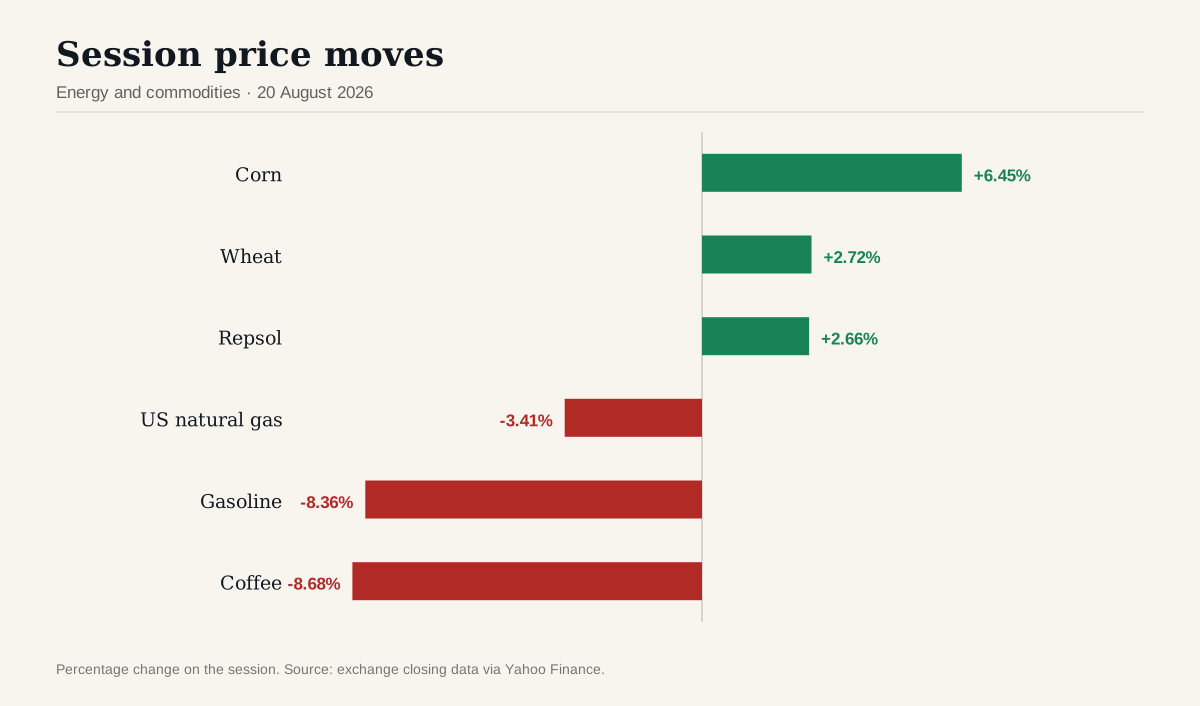
Corn led the session with a 6.45 per cent advance to 503.5 US cents a bushel on the Chicago Board of Trade, leaving the contract just 0.5 per cent below its 52-week high of 506.25. Volume ran at 2.51 times the 20-day average. The move extends a five-day gain of 12.39 per cent and a one-month rise of 8.98 per cent. European feed manufacturers, starch producers and ethanol plants now face the highest corn input costs in a year, with the stronger euro only partially offsetting the dollar-denominated rally.
- Corn (CBOT): 503.5 USX, +6.45% day, +12.39% five-day, 0.5% below 52-week high
- Gasoline (NYMEX): USD 2.9831/gal, -8.36% day, -12.64% one-month, 22.0% below 52-week high
- Coffee (ICE): 328.3 USX, -8.68% day, 25.0% below 52-week high
- EUR/USD: 1.1677, +0.84% day, 2.9% below 52-week high
- Repsol (MCE): EUR 28.14, +2.66% day, +14.86% one-month, 0.3% below 52-week high
Energy contracts diverge as gasoline leads losses
| Instrument | Close | Day | 5-day | Volume vs avg |
|---|---|---|---|---|
| Corn USX | 503.5 | +6.45% | +12.39% | 2.51x |
| Wheat USX | 698.75 | +2.72% | +7.05% | 0.92x |
| Repsol EUR | 28.14 | +2.66% | +6.23% | 0.84x |
| US natural gas USD | 2.72 | -3.41% | -0.33% | 1.01x |
| Gasoline USD | 2.98 | -8.36% | -4.63% | 1.16x |
| Coffee USX | 328.3 | -8.68% | -1.44% | 1.33x |
| Source: exchange closing data via Yahoo Finance, session of 2026-08-20. | ||||
Gasoline futures on the New York Mercantile Exchange fell 8.36 per cent to USD 2.9831 a gallon, the steepest single-session decline among the tracked benchmarks. The contract has now shed 12.64 per cent over the past month and sits 22.0 per cent below its 52-week high of 3.8232. Volume was 1.16 times the 20-day average. No specific announcement accompanied the move. For European refiners, the drop narrows the crack spread against Brent crude, pressuring refining margins at a time when utilisation rates have been climbing. Retail fuel prices in the eurozone, which track wholesale gasoline with a lag, may see downward pressure at the pump if the decline holds.
US natural gas slipped 3.41 per cent to USD 2.718 per million British thermal units, extending a one-month decline of 7.08 per cent. The contract remains 65.3 per cent below its 52-week high of 7.827, reached during the winter heating season. Volume was essentially average at 1.01 times the 20-day norm. Several headlines crossed the wires, including reports of Brazilian grid support from new gas-fired plants, Beijing's continued fossil-fuel investment alongside renewable expansion, and a near 200,000 bpd drop in Norwegian oil output linked to a Gulf supply crisis. None of the items directly explained the session's price action. European gas buyers, who benchmark against TTF rather than Henry Hub, will watch whether the US weakness feeds into transatlantic LNG arbitrage and eventually into European hub pricing.
Agricultural complex splits between grains and softs
Wheat rose 2.72 per cent to 698.75 US cents a bushel on CBOT, adding to a five-day gain of 7.05 per cent. The contract is 1.8 per cent below its 52-week high of 711.25. Volume was below average at 0.92 times the 20-day figure. A wire report noted wheat holding steady on Wednesday morning, while a separate item flagged a USD 5.4 million raise by Mafix to commercialise silicon fertilisers that remove CO2. The latter is early-stage and not material to near-term wheat fundamentals. European millers and bakers face a second consecutive month of rising wheat costs, though the one-month change remains slightly negative at -0.99 per cent.
Coffee plunged 8.68 per cent to 328.3 US cents a pound on ICE Futures, the session's largest percentage decline. The contract is now 25.0 per cent below its 52-week high of 437.95. Volume ran at 1.33 times the 20-day average. A corporate announcement from UNLOCKD regarding functional mushroom K-cups crossed the tape but is unrelated to the arabica futures move. European roasters and retail chains, which typically hedge several months forward, may see an opportunity to lock in lower green coffee costs for 2027 contracts if the selloff persists.
Repsol leads European majors higher
Repsol gained 2.66 per cent to EUR 28.14, placing it 0.3 per cent below its 52-week high of 28.23. The Spanish integrated energy company has risen 14.86 per cent over the past month and 6.23 per cent over five sessions. Volume was light at 0.84 times the 20-day average. The advance outperformed the broader European energy sector, which saw mixed trade as gasoline weakness offset crude resilience. Repsol's downstream exposure to Spanish and Portuguese refining margins makes it sensitive to the gasoline crack, though its upstream portfolio and renewable generation assets provide diversification. The share price is now more than double its 52-week low of 13.66, reflecting a recovery from the 2024-25 margin compression cycle.
Of the 20 companies in the tracked universe, 14 advanced and six declined. The breadth suggests broad-based buying interest despite the sharp divergence in underlying commodities. The euro's 0.84 per cent gain to USD 1.1677, its strongest level since early 2025, reduced the euro-cost of dollar-denominated energy and agricultural imports by a corresponding margin. The single currency is up 2.27 per cent over the past month and sits 2.9 per cent below its 52-week high of 1.2024.
Cost implications for European industry
The corn rally feeds directly into livestock feed costs for European meat and dairy producers, particularly in Spain, France, Germany and Poland, where compound feed formulations rely heavily on maize. Ethanol producers in France and Germany, which blend into the EU petrol pool, face margin squeeze unless gasoline prices recover. The gasoline drop, if sustained, lowers blending economics but reduces pump prices, creating a mixed signal for biofuel demand.
For chemical companies such as BASF, Covestro and Lanxess, natural gas remains a primary feedstock and power input. The Henry Hub decline is a US benchmark; European TTF pricing has not been supplied in this session's data. However, a persistent US discount supports LNG exports to Europe, which over time caps European hub prices. The 65.3 per cent distance from the 52-week high shows how far the market has moved from the 2022-23 energy crisis peaks.
Coffee's 25 per cent retreat from its high offers relief to roasters including Nestlé, JDE Peet's and Strauss Group, though hedge books mean the benefit will phase in over coming quarters. Wheat's proximity to its yearly high keeps pressure on bakery margins across the continent, where labour and energy costs have also risen.
The next key date is the USDA crop production report due 12 September, which will update yield forecasts for corn and soybeans and could confirm or reverse the current bullish grain tone.
Repsol · three-month price
Chart: TradingView. Live prices may differ from the closing figures quoted above.