
Corn futures jump 6% as fertilizer uncertainty lifts agricultural markets; WTI nears $90
Corn leads a 21.65% monthly rise, raising input costs for European food and feed producers, while WTI crude's 5% daily gain pushes energy bills higher, offset slightly by a stable euro.
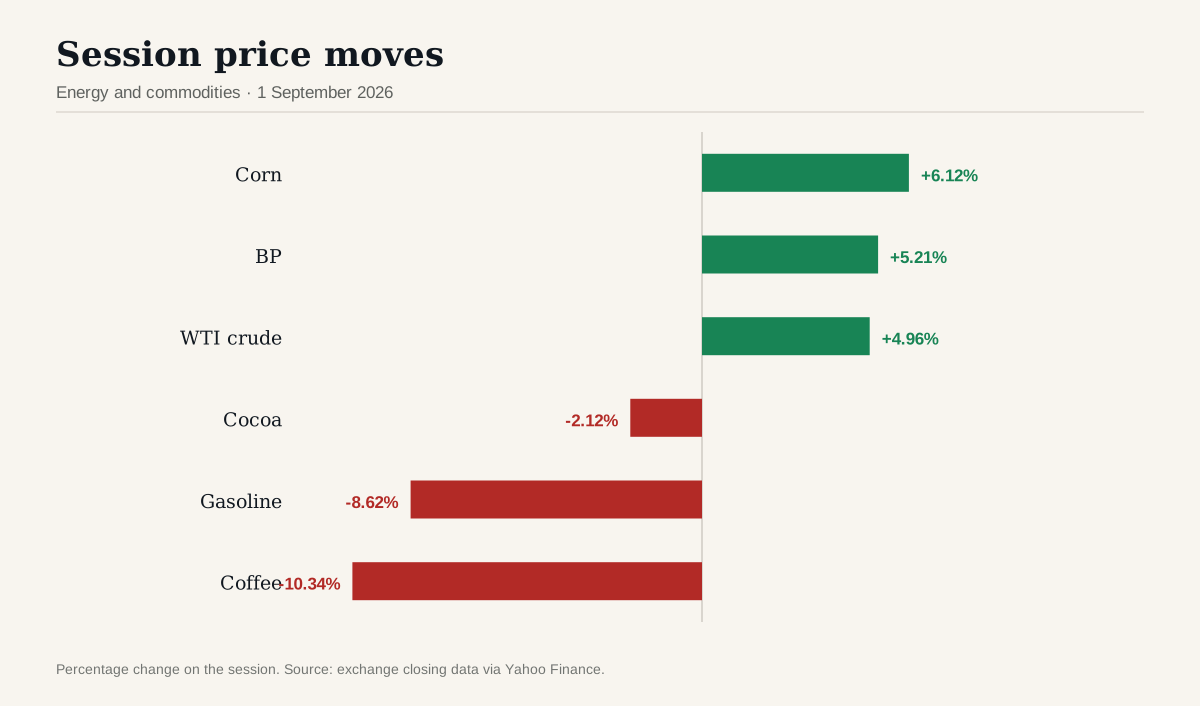
Corn futures surged 6.12% on 2026-09-01, leading a broad rally in agricultural commodities, while WTI crude neared $90 a barrel amid Middle East tensions, lifting shares of BP. Coffee futures dropped sharply, and gasoline prices fell, creating mixed cost pressures for European businesses. The moves show volatility in key input markets, affecting food manufacturers, energy‑intensive industries, and retail margins.
- Corn (CBOT) closed at 546.5 USX, up 6.12% on the day and 21.65% over the month, 0.3% below its 52-week high.
- WTI crude (NYMEX) rose 4.96% to $90.01, gaining 9.29% over five days, 24.7% below its 52-week high.
- BP (LSE) closed at 541.3 GBp, up 5.21% on the day, 11.2% below its 52-week high.
- Coffee (ICE) fell 10.34% to 308.35 USX, dropping 16.98% over five days, 29.6% below its 52-week high.
- Euro against the dollar closed at 1.1592, up 0.02% on the day, 3.6% below its 52-week high.
Corn leads agricultural gains amid fertilizer uncertainty
| Instrument | Close | Day | 5-day | Volume vs avg |
|---|---|---|---|---|
| Corn USX | 546.5 | +6.12% | +9.19% | 1.79x |
| BP GBp | 541.3 | +5.21% | +1.42% | 1.75x |
| WTI crude USD | 90.01 | +4.96% | +9.29% | 1.08x |
| Cocoa USD | 6,509 | -2.12% | +13.02% | 2.11x |
| Gasoline USD | 3.14 | -8.62% | -3.45% | 1.06x |
| Coffee USX | 308.35 | -10.34% | -16.98% | 2.78x |
| Source: exchange closing data via Yahoo Finance, session of 2026-09-01. | ||||
Corn futures extended their August rally into September, closing at 546.5 USX, just 0.3% below their 52-week high of 548 USX. The 6.12% daily gain capped a 21.65% rise over the month, driven by persistent fertilizer uncertainty and expectations of tighter supply. Reports that Pivot Bio, a provider of microbial fertilizer, is expanding farmer support for 2027 reflect ongoing concerns about traditional fertilizer availability, which has contributed to higher corn prices.
For European businesses, the surge in corn prices carries direct cost implications. Corn is a key input for animal feed, used by major meat producers like Denmark's Danish Crown and Germany's Tönnies, and for processed food manufacturers such as Nestlé and Unilever, which use corn derivatives in products ranging from cereals to sweeteners. A 21.65% monthly rise in corn prices will likely pressure margins unless these costs can be passed to consumers, who are already grappling with elevated food inflation. Agricultural equipment makers like Deere, which Baird highlighted as a beneficiary of an impending agricultural recovery, may also see increased demand as farmers invest in efficiency to offset higher input costs.
WTI nears $90 as Middle East tensions persist
WTI crude rose 4.96% to $90.01 a barrel, extending a five-day gain of 9.29%, after reports of U.S. strikes against Iranian targets near the Strait of Hormuz. The geopolitical escalation has heightened concerns about supply disruptions in a key oil transit chokepoint, supporting prices. For European buyers, the dollar-denominated crude price increase was slightly offset by a stable euro, which closed at 1.1592, up 0.02% on the day. Over five days, the euro has fallen 0.66%, however, which has amplified the impact of rising crude prices for European importers.
The rise in WTI comes as gasoline futures dropped 8.62% to $3.1407 a gallon, a divergence that signals potential pressure on refining margins. European refiners like Italy's Eni and France's TotalEnergies, which rely on crack spreads (the difference between crude and refined product prices) for profitability, may see narrower margins if gasoline demand weakens. The drop in gasoline prices, which had hit a dubious record in August, could offer some relief to European transport and logistics firms, but the persistence of high crude prices suggests any relief may be temporary.
BP outperforms European energy majors
BP shares rose 5.21% to 541.3 GBp on the London Stock Exchange, outperforming other European energy majors, with volume 1.75 times the 20-day average. The gain came despite a 2.03% decline over the past month, reflecting a broader recovery in oil prices. BP's 52-week range of 399.35 to 609.4 GBp means the stock remains 11.2% below its high, leaving room for further upside if oil prices continue to rise. No specific company announcement accompanied the rally, suggesting investors are reacting to the broader improvement in the energy price environment.
For BP, the rise in WTI prices supports its upstream business, which benefits from higher realized prices for oil. The company's integrated model, which includes refining and marketing, may also help offset some of the pressure from narrower crack spreads. However, BP's performance contrasts with the 13-7 split of rising and falling energy and commodities companies, indicating that not all firms are benefiting equally from the current market conditions.
Coffee, gasoline lead declines; cocoa eases
Coffee futures dropped 10.34% to 308.35 USX, erasing some of their recent gains, with a five-day decline of 16.98%. The drop, which follows a period of strong performance for agricultural ETFs that have outpaced the S&P 500 for two months, may offer relief to European coffee roasters like Italy's Lavazza and Germany's Tchibo, which have faced rising input costs. However, coffee prices remain 29.6% below their 52-week high, suggesting the market may still be volatile.
Gasoline futures fell 8.62% to $3.1407 a gallon, a sharp reversal after August's record prices. The decline could ease costs for European transport companies, including logistics firms like Germany's DHL and France's Geodis, which rely on gasoline and diesel for their fleets. Cocoa futures also eased 2.12% to $6,509 a ton, though they remain up 13.02% over five days and 9.60% over the month, supported by concerns about West African crop yields. For chocolate manufacturers like Switzerland's Lindt & Sprüngli, the recent cocoa price surge remains a key margin headwind.
Implications for European business margins
The day's moves highlight the mixed cost pressures facing European businesses. On one hand, rising corn and crude prices are pushing up input costs for food, energy, and manufacturing firms, threatening margins. On the other, declines in coffee and gasoline prices offer some relief to sectors like retail, transport, and food services. The euro's stability against the dollar, meanwhile, has helped mitigate the impact of dollar-denominated commodity price increases, though its five-day decline has offset some of this benefit.
The divergence between rising commodities and mixed company performance (13 of 20 traded companies rose, 7 fell) shows that some firms can pass on cost increases while others cannot. Energy majors like BP, which benefit directly from higher oil prices, are likely to outperform, while consumer staples firms may face greater challenges as they try to balance margin preservation with consumer affordability.
Corn futures will settle for September delivery on 2026-09-15, with traders watching whether the 52-week high of 548 USX is breached before then. A break above this level would add to the cost pressures facing European food and feed producers.
BP · three-month price
Chart: TradingView. Live prices may differ from the closing figures quoted above.