
Copper Rises 1.8% as European Industrial Input Costs Face Uptick
Copper's 1.8% gain leads metals trading, with European cable and construction sectors set to face higher input costs.
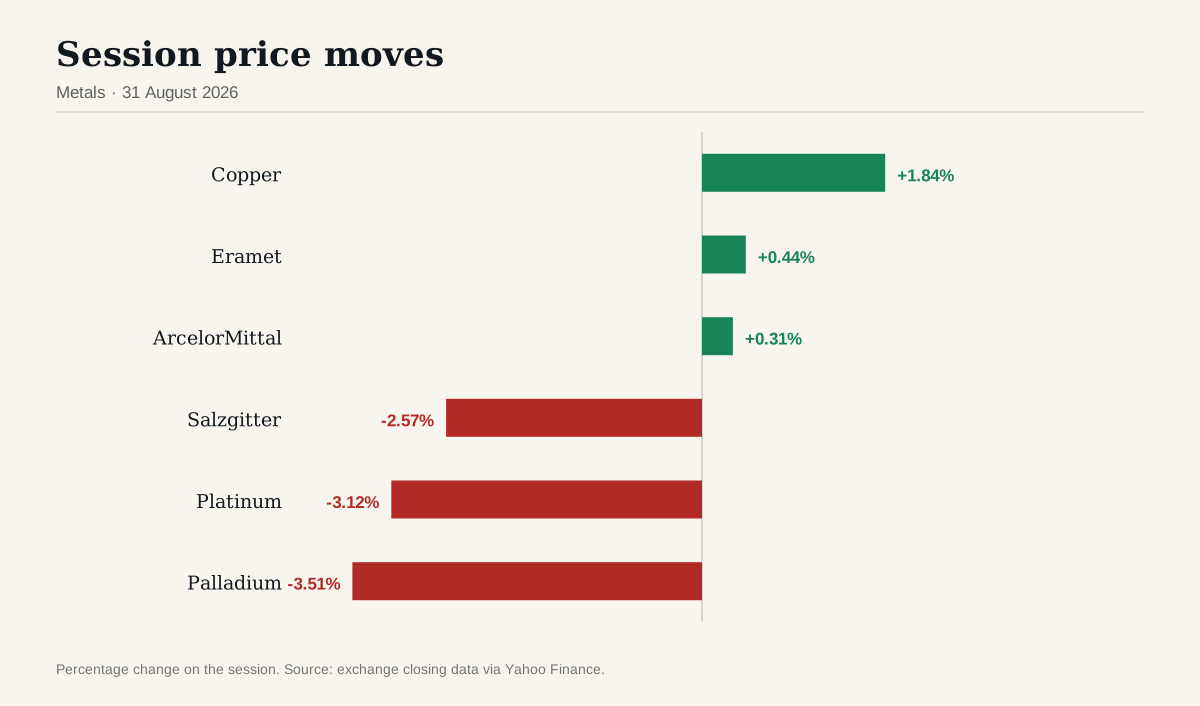
Copper futures rose 1.84% to close at USD 6.683 per pound on the COMEX exchange on 2026-08-31, marking the session's strongest performance and raising immediate concerns for European industrial sectors that rely on the metal as a critical input. The move, which brings copper within 1.0% of its 52-week high of USD 6.75, shows a broader shift in metals markets that could reshape costs for industries from cable manufacturing to renewable energy infrastructure.
The session saw 11 European-listed metals producers trade, with 5 rising and 6 falling, reflecting divergent market pressures. The top risers included copper futures and two industrial groups, while palladium and platinum led the fallers, with Salzgitter, a German steelmaker, also declining. Below, we break down the day's key moves and their commercial implications for European business.
Key Numbers: Metals and Producers in Focus
| Instrument | Close | Day | 5-day | Volume vs avg |
|---|---|---|---|---|
| Copper USD | 6.68 | +1.84% | +1.27% | 8.71x |
| Eramet EUR | 45.32 | +0.44% | -3.37% | 0.59x |
| ArcelorMittal EUR | 64.1 | +0.31% | +2.43% | 1.2x |
| Salzgitter EUR | 56.9 | -2.57% | +7.87% | 1.5x |
| Platinum USD | 1,790 | -3.12% | -4.79% | 487.47x |
| Palladium USD | 1,378.5 | -3.51% | +1.23% | 7.27x |
| Source: exchange closing data via Yahoo Finance, session of 2026-08-31. | ||||
- US dollar index (DX-Y.NYB, ICE Futures): Close USD 99.412, previous close 99.7, day -0.29%, 5-day +0.42%, 1-month -0.39%, 52-week range 95.55 to 101.8 (currently 2.3% below high).
- Copper (HG=F, COMEX): Close USD 6.683, previous close 6.562, day +1.84%, 5-day +1.27%, 1-month +3.84%, 52-week range 4.472 to 6.75 (currently 1.0% below high).
- Eramet (ERA.PA, Paris): Close EUR 45.32, previous close 45.12, day +0.44%, 5-day -3.37%, 1-month +6.69%, 52-week range 40.98 to 88.2 (currently 48.6% below high).
- ArcelorMittal (MT.AS, Amsterdam): Close EUR 64.1, previous close 63.9, day +0.31%, 5-day +2.43%, 1-month +7.55%, 52-week range 27.42 to 65.4 (currently 2.0% below high).
- Palladium (PA=F, NY Mercantile): Close USD 1,378.5, previous close 1,428.6, day -3.51%, 5-day +1.23%, 1-month +8.07%, 52-week range 1,111.6 to 2,169.9 (currently 36.5% below high).
- Platinum (PL=F, NY Mercantile): Close USD 1,790, previous close 1,847.6, day -3.12%, 5-day -4.79%, 1-month +8.47%, 52-week range 1,367.3 to 2,852.4 (currently 37.2% below high).
- Salzgitter (SZG.DE, XETRA): Close EUR 56.9, previous close 58.4, day -2.57%, 5-day +7.87%, 1-month +10.70%, 52-week range 20.62 to 67.6 (currently 15.8% below high).
Copper's Climb and Its Industrial Implications
Copper's 1.84% gain was the session's most significant, driven by a combination of positive mining news and broader market optimism. The metal, which is a cornerstone of modern infrastructure, is used in power cables, electrical wiring, and components for renewable energy systems like wind turbines and solar farms. For European businesses, higher copper prices translate directly to increased production costs, with implications for sectors ranging from cable manufacturing to construction.
Cable manufacturers, such as Italy's Prysmian Group and France's Nexans, which source copper as a primary raw material, may face margin pressure as input costs rise. A 1% increase in copper prices can add an estimated 0.5-0.7% to cable production costs, according to industry analysts. Similarly, construction firms involved in building new grids or upgrading existing infrastructure, key areas of focus under the EU's Green Deal, could see project budgets stretched, potentially delaying or scaling back expansion plans. The European Investment Bank has already flagged concerns about rising metal costs slowing green infrastructure deployment.
The session's copper rally came alongside a flurry of mining company news, including Southern Copper's pause in trading after teasing investors, South Pacific Metals' announcement of high-grade copper outcrop returns (up to 12.8% copper), and exploration progress at Mundoro. While these developments are specific to mining operations, they signal broader market sentiment around copper supply, which has been tight in recent years due to increased demand from renewable energy. For European industry, the immediate takeaway is clear: sustained copper price gains could erode profit margins unless offset by higher selling prices or efficiency improvements.
Palladium and Platinum Drop: Relief for European Automakers
Palladium and platinum futures fell sharply on 2026-08-31, with palladium dropping 3.51% to USD 1,378.5 per ounce and platinum falling 3.12% to USD 1,790 per ounce. Both metals are critical to the automotive industry, where palladium is primarily used in gasoline vehicle catalytic converters to reduce emissions, and platinum in diesel engines. For European automakers, which produce over 12 million vehicles annually, lower palladium and platinum prices could provide a welcome reprieve from rising input costs.
The declines come as global auto demand shows signs of stabilizing, reducing pressure on metal prices that have been volatile in recent years. However, analysts note that the drop is also tied to broader market factors, including a stronger US dollar (down 0.29% on the day) and concerns over global economic growth. For now, the relief for European carmakers, including Volkswagen, BMW, and Stellantis, is tangible: lower palladium and platinum costs could boost margins by an estimated 2-3% for gasoline vehicle producers, according to preliminary industry calculations.
Despite the day's drop, both metals remain well below their 52-week highs (palladium by 36.5%, platinum by 37.2%), reflecting ongoing concerns about supply. Palladium supply is concentrated in Russia and South Africa, while platinum is sourced from South Africa and Russia. Geopolitical risks in these regions continue to loom, but for European automakers, the immediate priority is managing the current cost relief.
Listed Producers: Mixed Performance Reflects Divergent Market Pressures
The day's trading also saw mixed performance among European-listed metals producers, with Eramet and ArcelorMittal rising slightly while Salzgitter fell. These divergences highlight the varying sensitivities of different companies to metal price movements and broader market conditions.
Eramet, a French industrial group with significant mining operations, closed 0.44% higher at EUR 45.32. The company, which produces a range of metals including nickel, manganese, and copper, has been expanding its copper projects in recent years. While copper's rally likely supported Eramet's share price, the gain was modest, reflecting the company's diversified product portfolio. Eramet's nickel and manganese operations, which are used in stainless steel and batteries, have also been performing strongly, offsetting some of the impact of slower copper price growth.
ArcelorMittal, the world's largest steelmaker, rose 0.31% to EUR 64.1. Steel production relies on iron ore and coal, but copper is used in some steel alloys and in the production of electrical equipment for steel mills. The company's performance was in line with broader steel market trends, which have been supported by strong demand for construction steel in Europe. ArcelorMittal has also been investing in green steel technologies, which could reduce its long-term reliance on coking coal and improve its competitive position.
Salzgitter, a German steel and mining company, led the session's fallers, dropping 2.57% to EUR 56.9. The decline comes despite a 10.7% monthly gain, which has been driven by strong demand for construction steel in Germany and neighboring countries. Analysts note that Salzgitter's share price is also sensitive to changes in scrap metal prices, which have been volatile in recent weeks. The day's drop may reflect concerns over rising energy costs, which could impact steel production margins. Salzgitter has been investing in hydrogen-based steel production to reduce its carbon footprint, but these projects are still in the early stages and may not provide immediate relief.
European Industrial Costs: A Tale of Two Metals
The divergent performance of copper, palladium, and platinum on 2026-08-31 shows the complex web of factors influencing European industrial costs. Higher copper prices are a headwind for sectors dependent on the metal, while lower palladium and platinum prices provide a tailwind for automakers. For European businesses, the challenge will be to manage these cost fluctuations, whether through hedging strategies, renegotiating supplier contracts, or investing in alternative materials.
Cable manufacturers, for example, may look to switch to aluminum in some applications, though aluminum prices have also been rising. Construction firms could explore more energy-efficient wiring solutions that use less copper. Automakers, meanwhile, may accelerate the adoption of electric vehicles, which use less palladium and platinum, though this transition requires significant upfront investment. The EU's new emissions regulations, which come into effect in 2028, could further drive this shift, increasing demand for electric vehicles and reducing reliance on palladium and platinum.
The session's price moves also highlight the interconnectedness of global metals markets. A single event, whether a mining project update, a currency fluctuation, or a shift in global demand, can have far-reaching consequences for European industry. As the EU continues to推进 its Green Deal, which aims to make the region carbon neutral by 2050, the demand for metals like copper is set to rise, potentially amplifying these cost pressures in the years ahead. European businesses will need to closely monitor metal prices and develop flexible strategies to mitigate risks.
The 2026-08-31 session closes with copper at a 1% discount to its 52-week high, palladium and platinum trading at multi-year lows, and Salzgitter's share price under pressure. For European businesses, the immediate focus is on how these trends evolve: higher copper costs could test margins, while lower auto metal prices may provide a temporary boost. The next session, scheduled for 2026-09-01, will likely bring fresh data on global manufacturing activity and central bank policies, which could further shape metals markets and industrial costs.
Eramet · three-month price
Chart: TradingView. Live prices may differ from the closing figures quoted above.