
Corn jumps 4 per cent on Black Sea supply risk while European energy majors slide
Grain markets tighten as Russia-Ukraine tensions resurface, lifting corn to a 22 per cent monthly gain, while Eni and TotalEnergies fall despite crude stability and the euro edges higher against the dollar.
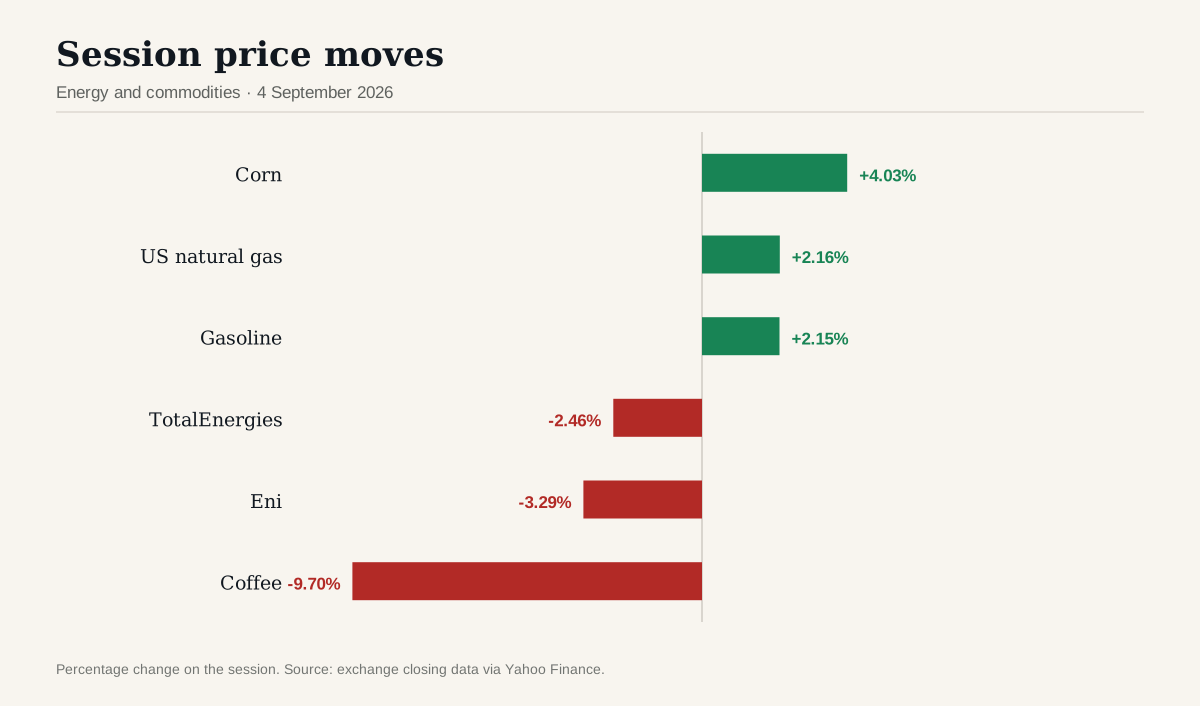
Corn futures on the Chicago Board of Trade surged 4.03 per cent to 536 US cents a bushel on Friday, the largest single-session move across the energy and commodities complex tracked by EuroTelegraph, as renewed tension between Russia and Ukraine threatened to disrupt Black Sea export flows. The rally extended a 22.1 per cent monthly advance that has brought the contract to within 1.6 per cent of its 52-week high of 544.75 US cents. For European food manufacturers, livestock producers and biofuel refiners, the move raises input costs at a moment when the euro has only marginally recovered against the dollar, leaving the currency cushion thin.
- Corn (ZC=F): 536 US cents/bushel, +4.03% day, +22.10% 1-month, 1.6% below 52-week high
- US natural gas (NG=F): $2.976/MMBtu, +2.16% day, +12.73% 1-month, 62.0% below 52-week high
- Gasoline (RB=F): $3.2024/gallon, +2.15% day, +8.98% 1-month, 16.2% below 52-week high
- Coffee (KC=F): 292.9 US cents/lb, -9.70% day, -15.31% 5-day, -8.94% 1-month, 33.1% below 52-week high
- Eni (ENI.MI): €23.075, -3.29% day, -1.39% 1-month, 7.8% below 52-week high
- TotalEnergies (TTE.PA): €76.10, -2.46% day, +2.09% 1-month, 6.4% below 52-week high
- EUR/USD: 1.1614, +0.25% day, 3.4% below 52-week high
Grain markets price Black Sea disruption risk
| Instrument | Close | Day | 5-day | Volume vs avg |
|---|---|---|---|---|
| Corn USX | 536 | +4.03% | +4.69% | 1.38x |
| US natural gas USD | 2.98 | +2.16% | +3.05% | 0.8x |
| Gasoline USD | 3.2 | +2.15% | -8.24% | 0.95x |
| TotalEnergies EUR | 76.1 | -2.46% | +1.92% | 1.3x |
| Eni EUR | 23.08 | -3.29% | +1.25% | 1.25x |
| Coffee USX | 292.9 | -9.70% | -15.31% | 2.52x |
| Source: exchange closing data via Yahoo Finance, session of 2026-09-04. | ||||
The corn rally followed headlines citing a renewed threat to global grain supplies from the Russia-Ukraine corridor. No specific vessel inspections, port closures or quota changes were announced in the session, but the market reacted to the narrative risk that the Black Sea Grain Initiative's fragile successors could be jeopardised. Ukraine and Russia together account for roughly 30 per cent of global wheat exports and a significant share of corn shipments; any interruption forces buyers toward US, Brazilian or Argentine origin, widening freight spreads and raising delivered costs into European feed mills and starch plants.
At 536 US cents, corn is up 142 cents from the 52-week low of 394 cents touched earlier in the cycle. The 1.38 times average volume suggests institutional participation rather than short-covering alone. European compound feed producers, already managing elevated soymeal costs, now face a double squeeze: higher grain prices and a euro that has gained only 0.49 per cent over the past month against the dollar, leaving the currency offset minimal. A German or French feed buyer paying in euro sees almost the full dollar move transmitted to the invoice.
US natural gas climbs on infrastructure news, not fundamentals
Henry Hub natural gas rose 2.16 per cent to $2.976 per MMBtu, extending a 12.73 per cent monthly gain. The session's catalyst was the completion of Williams Companies' $5.5 billion acquisition of Momentum Midstream, which expands Williams' footprint in the Haynesville shale. The deal consolidates gathering and processing capacity but does not immediately alter production volumes. Separately, reports that the UK is poised to approve the Jackdaw gas field in the North Sea added a European supply angle, though first gas from Jackdaw remains years away.
Despite the monthly advance, the contract sits 62 per cent below its 52-week high of $7.827, reflecting the structural oversupply that has characterised the US market since late 2025. European gas buyers, who reference TTF rather than Henry Hub, benefit indirectly only if LNG arbitrage economics shift. With US storage reported as adequate by analysts, the rally lacks a fundamental storage-draw driver. For European chemical and fertiliser producers, the relevant benchmark remains the Dutch TTF, which was not included in today's dataset but typically correlates loosely with US prices net of liquefaction and shipping costs.
Gasoline gains as refining margins hold
RBOB gasoline futures advanced 2.15 per cent to $3.2024 per gallon, up 8.98 per cent over the month but still 16.2 per cent below the 52-week high of $3.8232. The move occurred despite a 5-day decline of 8.24 per cent, suggesting a short-term oversold bounce rather than a demand-led recovery. European refiners such as TotalEnergies, Eni, Repsol and Saras crack spreads benefit when gasoline strength outpaces Brent crude, but the majors' equity performance today diverged: both Eni and TotalEnergies fell even as product cracks improved.
The divergence hints at portfolio effects. TotalEnergies completed its Galp swap to become operator of Namibia's Mopane discovery, a deepwater exploration play with no near-term cash flow. Eni's exposure to European gas marketing and Libyan production risk may have weighed more heavily than the refining tailwind. Volume in gasoline futures was 0.95 times the 20-day average, indicating modest conviction.
Coffee collapses on technical liquidation and corporate noise
Arabica coffee futures plunged 9.70 per cent to 292.9 US cents per pound, the session's sharpest decline, on volume 2.52 times the 20-day average. The contract has shed 15.31 per cent in five sessions and now sits 33.1 per cent below its 52-week high of 437.95 cents. No supply-side shock was reported; instead, headlines highlighted a Nasdaq notification to Reborn Coffee regarding a late 10-Q filing and continued listing requirements, alongside a generic caution note on three mid-cap stocks. The corporate news is unrelated to the physical coffee market but may have triggered algorithmic selling in a thinly traded futures contract.
For European roasters, Nestlé, JDE Peet's, Lavazza, Tchibo, the drop reduces green bean costs after a prolonged rally that squeezed margins through 2025. However, the speed of the decline creates hedging losses for those who locked in higher prices. The 52-week range of 242.7 to 437.95 cents shows the volatility that makes coffee a large contributor to food manufacturing input cost variance.
European energy majors decouple from product strength
Eni fell 3.29 per cent to €23.075 on volume 1.25 times average, while TotalEnergies dropped 2.46 per cent to €76.10 on 1.3 times average volume. Both stocks trade below their 52-week highs by 7.8 per cent and 6.4 per cent respectively. The declines occurred despite supportive refining margins and, in TotalEnergies' case, positive exploration news from Namibia. Analyst research calls published Friday included TotalEnergies and Shell among the names reviewed, but no rating changes were flagged in the headlines.
The disconnect suggests investors are pricing portfolio-level concerns: European gas marketing margins under pressure from weak industrial demand, upstream capital intensity in deepwater and North Sea assets, and the ongoing strategic debate over return of capital versus energy transition spending. Eni's 5-day gain of 1.25 per cent and TotalEnergies' 1.92 per cent 5-day rise show the session reversed a short-term uptrend. For equity investors, the majors now offer dividend yields above 5 per cent but with earnings visibility tied to a commodity complex that is sending mixed signals.
Currency cushion narrows for European importers
The euro closed at $1.1614, up 0.25 per cent on the day and 0.49 per cent over the month, but remains 3.4 per cent below its 52-week high of 1.2024. For a European buyer of dollar-denominated commodities, the currency move offsets only a fraction of the corn rally and does nothing to mitigate the coffee drop's hedging losses. A German importer paying for US corn in euro sees the full 4 per cent daily increase translated to the balance sheet; the euro's 0.25 per cent gain reduces the effective increase to roughly 3.75 per cent. Over the month, corn's 22.1 per cent dollar rise is only partially dampened by the euro's 0.49 per cent appreciation.
The 52-week range of 1.1325 to 1.2024 shows the euro has traded in a 6.2 per cent band. At current levels, the currency is closer to the low than the high, limiting the natural hedge for European industry. ECB policy expectations, not commodity flows, will drive the next leg.
What it means for European costs
Food manufacturers face higher grain bills with limited currency relief. Feed compounders in France, Germany, Spain and Poland will pass costs to livestock producers, eventually reaching retail meat and dairy prices. Biofuel producers blending ethanol from corn see margins compressed unless gasoline cracks widen further. Chemical companies using gas as feedstock gain little from the Henry Hub move; their benchmark is TTF, which has decoupled from US prices since the 2022 crisis. Refiners capture stronger gasoline cracks but equity markets are not rewarding the spread improvement, suggesting scepticism about sustainability. Coffee roasters get a cost reprieve but must manage hedge book losses.
TotalEnergies' Namibia operator role and Williams' Haynesville consolidation are long-horizon supply stories. The next concrete dated event is the UK Jackdaw field approval decision, expected in the coming weeks, which would add North Sea volumes from the late 2020s. Until then, European energy costs remain hostage to TTF gas, Brent crude and the euro-dollar rate, three variables that moved in different directions on Friday.
Eni · three-month price
Chart: TradingView. Live prices may differ from the closing figures quoted above.