
Copper edges higher as European input costs tighten
Copper futures rose 1.16% to US$6.6535 per pound on 4 September 2026, nudging the cost base for cable manufacturers, construction firms and grid investors while steel‑related equities showed mixed reactions.
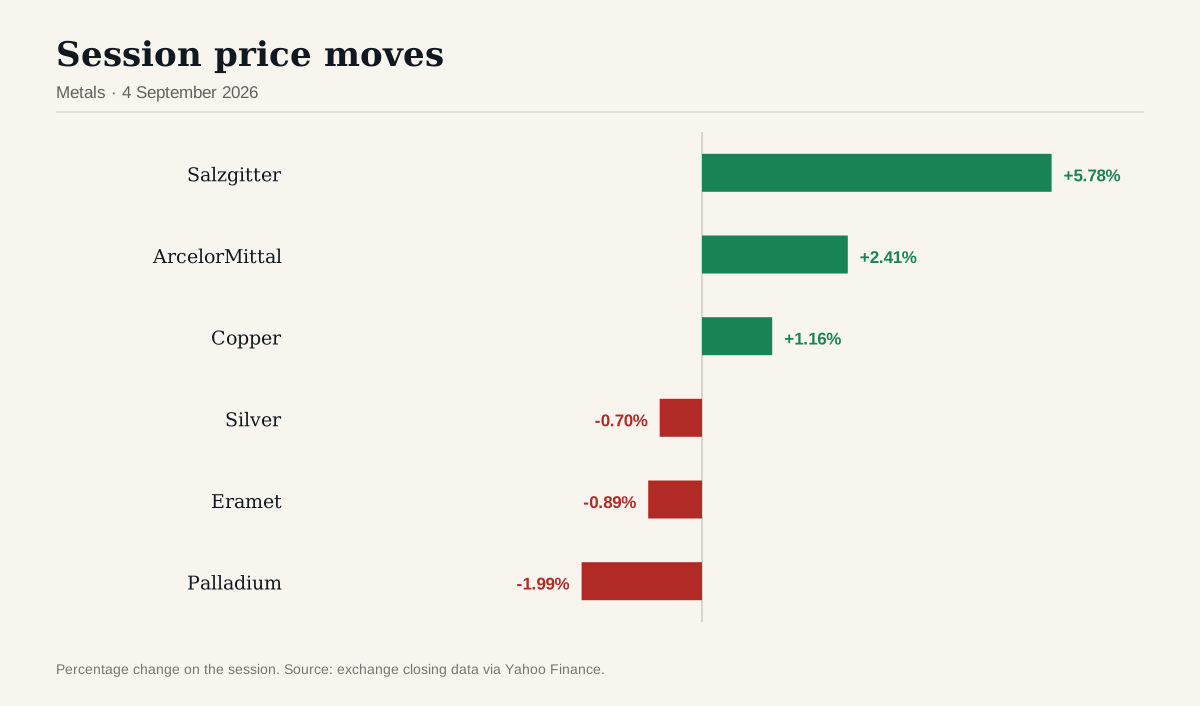
Copper futures closed at US$6.6535 on the COMEX, up 1.16% from the previous close of US$6.577. The move represents the largest single‑day gain among the three major metals tracked in the session and signals a modest increase in the input cost for European industries that rely on copper for wiring, renewable‑energy infrastructure and building projects.
- Copper futures close US$6.6535 per pound, +1.16% on the day
- Salzgitter shares close €60.35, +5.78% on the day
- Palladium futures close US$1,397.5 per ounce, -1.99% on the day
Metal price movements
| Instrument | Close | Day | 5-day | Volume vs avg |
|---|---|---|---|---|
| Salzgitter EUR | 60.35 | +5.78% | +4.32% | 1.4x |
| ArcelorMittal EUR | 67.24 | +2.41% | +4.09% | 1.76x |
| Copper USD | 6.65 | +1.16% | +1.39% | 11.86x |
| Silver USD | 66.51 | -0.70% | -0.73% | 24.42x |
| Eramet EUR | 44.46 | -0.89% | -2.20% | 0.5x |
| Palladium USD | 1,397.5 | -1.99% | -2.18% | 9.27x |
| Source: exchange closing data via Yahoo Finance, session of 2026-09-04. | ||||
The copper price sits 1.4% below its 52‑week high of US$6.75 and 0.5% above its 52‑week low of US$4.472. Volume on the contract was 11.86 times the 20‑day average, indicating heightened trading activity relative to recent weeks. The modest rise follows a 5‑day gain of 1.39% and a 1‑month decline of 0.50%, suggesting a short‑term bounce after a period of slight weakness.
By contrast, palladium fell 1.99% to US$1,397.5 per ounce, a level 35.6% below its 52‑week high of US$2,169.9 and 20.0% above its 52‑week low of US$1,111.6. Trading volume was 9.27 times the 20‑day average, reflecting strong interest despite the price drop. Silver also slipped 0.70% to US$66.505 per ounce, remaining 45.2% below its 52‑week high of US$121.3.
The US dollar index, a proxy for the strength of the greenback, edged up 0.16% to close at 99.16, 2.6% below its 52‑week high. A firmer dollar typically exerts downward pressure on commodity prices priced in dollars, making the copper rise noteworthy in the context of a slightly stronger currency.
Listed producers and their market reactions
Salzgitter (SZG.DE) posted the session's biggest equity gain, closing at €60.35, up 5.78% from €57.05. The share price is 10.7% below the 52‑week high of €67.6 and 71.4% above the 52‑week low of €21.52. Trading volume was 1.4 times the 20‑day average, indicating that investors responded positively to the price move despite no specific corporate announcement being attached to the session.
ArcelorMittal (MT.AS) added 2.41% to close at €67.24, up from €65.66. The stock sits 1.7% below its 52‑week high of €68.42 and 23.5% above its 52‑week low of €28.54. Volume was 1.76 times the 20‑day average. The company's press releases referenced developments in pyrolysis technology, renewable natural gas projects and strategic questions around its Italian exit, but the share move appears to be driven primarily by the broader metal price environment.
Eramet (ERA.PA) fell 0.89% to €44.46, down from €44.86. The price remains 49.6% below its 52‑week high of €88.2 and 8.3% above its 52‑week low of €40.98. Volume was half the 20‑day average, suggesting limited trading interest. No specific corporate news accompanied the decline, leaving the price movement to be interpreted against the backdrop of falling palladium and broader metal market softness.
Implications for European industrial costs
The rise in copper prices adds a marginal cost increase for sectors that consume the metal in large quantities. Cable manufacturers, for example, price contracts in euros but source copper on the global market, meaning a 1.16% rise in the dollar‑quoted price translates into a higher euro‑denominated input cost after accounting for the modestly stronger dollar index. Construction firms that purchase copper‑based wiring and plumbing components will see a similar effect, albeit limited by the relatively small percentage change.
Grid investors, particularly those involved in expanding renewable‑energy transmission networks, monitor copper closely because the metal is a key component of high‑capacity conductors. A price that remains within 1.4% of its annual peak suggests that budgeting for new projects will need to incorporate a slightly higher material expense, potentially affecting project economics if other cost components remain static.
On the steel side, the divergent equity moves of Salzgitter and ArcelorMittal highlight differing market perceptions of margin pressure. Both companies produce steel, an input for automotive manufacturing, construction and machinery. Salzgitter's strong share gain may indicate investor confidence that the company can sustain or improve margins despite the modest copper price rise, perhaps through cost‑control measures or product mix shifts. ArcelorMittal's more modest gain, coupled with its strategic announcements, suggests a focus on diversification into lower‑carbon processes, which could mitigate exposure to raw‑material price swings.
Eramet's decline, set against a backdrop of falling palladium, could signal concerns about the profitability of its nickel and manganese operations, which are often linked to automotive battery supply chains. Palladium's price drop reduces the cost of catalytic converters for internal‑combustion vehicles, potentially easing pressure on car manufacturers that still rely on the metal for emissions control. However, the broader industry trend toward electrification may limit the long‑term relevance of palladium price movements for European automakers.
Overall, the session's metal price dynamics suggest a modest upward pressure on input costs for sectors reliant on copper, while the decline in palladium offers a small cost relief for automotive emissions‑control components. Steel producers appear to be navigating these inputs with mixed equity responses, reflecting divergent expectations about margin resilience and strategic positioning.
Market breadth and currency backdrop
Of the 14 metal‑related companies that traded, five rose and nine fell, indicating a broadly negative sentiment across the sector despite copper's gain. The US dollar index's slight rise to 99.16, 2.6% below its 52‑week high, adds a modest currency headwind for dollar‑priced commodities, making copper's advance noteworthy.
Investors should note that the copper price remains 1.4% below its 52‑week high, while palladium is 35.6% below its peak. These distances from annual extremes provide a reference for assessing how far prices might move before encountering significant resistance or support levels, without implying any technical analysis.
Looking ahead
The next scheduled data release that could influence metal prices is the European Union's monthly industrial production report, due on 15 September 2026. The report measures industrial output across the euro area.
For now, the session closed on 4 September 2026 with copper at US$6.6535 per pound, Salzgitter at €60.35, and the US dollar index at 99.16.
Salzgitter · three-month price
Chart: TradingView. Live prices may differ from the closing figures quoted above.