
Corn and wheat surge lifts European food input costs as coffee collapses
CBOT grain futures jumped more than four per cent in heavy volume while arabica coffee fell 10.6 per cent, leaving European processors facing divergent raw material pressures.
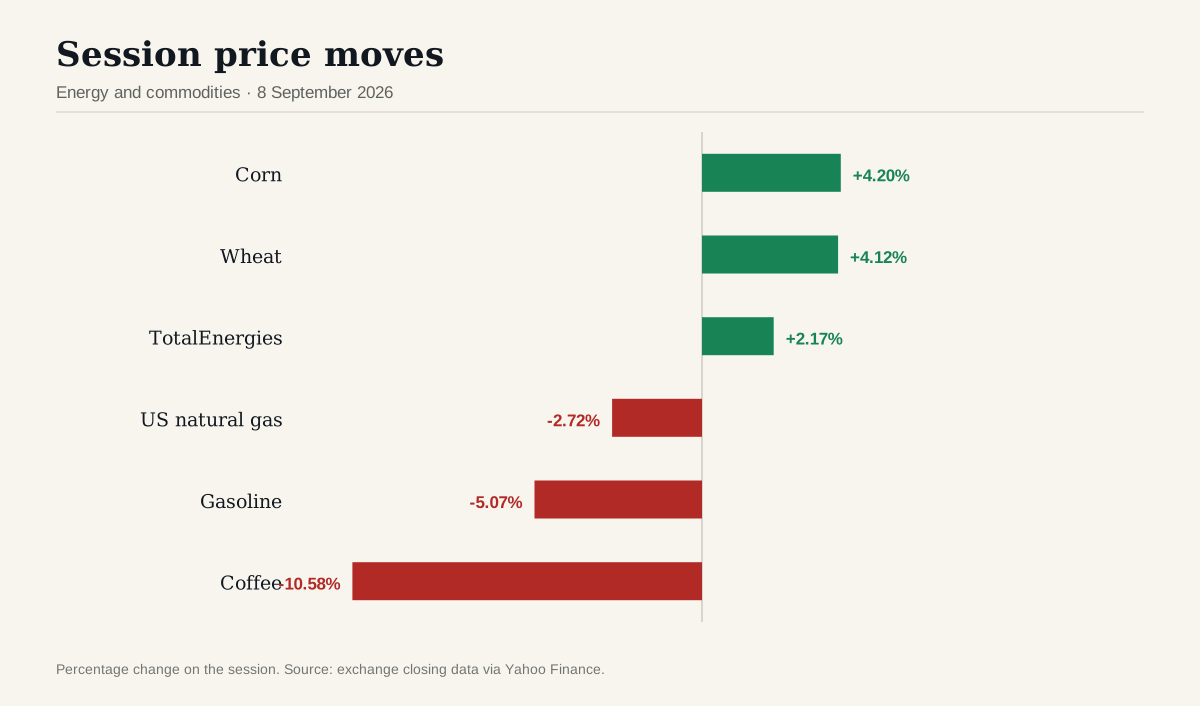
Corn and wheat futures on the Chicago Board of Trade both rose more than four per cent on Monday in volumes well above their 20-day averages, pushing the two staple grains to within two and four per cent respectively of their 52-week highs. At the same time, ICE arabica coffee futures dropped 10.6 per cent to 289.95 US cents per pound, the sharpest single-session fall among the tracked contracts, on volume nearly five times the 20-day average. The moves leave European food manufacturers, livestock producers and retailers with a split picture: grain costs accelerating just as the coffee bill eases.
- Corn (ZC=F): 533.5 US cents per bushel, +4.20% day, +21.53% one month, volume 1.72x 20-day average, 1.8% below 52-week high
- Wheat (ZW=F): 745.5 US cents per bushel, +4.12% day, +16.53% one month, volume 1.78x 20-day average, 3.9% below 52-week high
- Coffee (KC=F): 289.95 US cents per pound, -10.58% day, -13.59% one month, volume 4.8x 20-day average, 33.8% below 52-week high
- EUR/USD: 1.1629, +0.13% day, 3.3% below 52-week high
- TotalEnergies (TTE.PA): €77.75, +2.17% day, +4.94% one month, 4.4% below 52-week high
Agricultural contracts diverge sharply
| Instrument | Close | Day | 5-day | Volume vs avg |
|---|---|---|---|---|
| Corn USX | 533.5 | +4.20% | +3.59% | 1.72x |
| Wheat USX | 745.5 | +4.12% | -1.45% | 1.78x |
| TotalEnergies EUR | 77.75 | +2.17% | +2.94% | 0.62x |
| US natural gas USD | 2.89 | -2.72% | -1.40% | 1.33x |
| Gasoline USD | 3.05 | -5.07% | -11.21% | 1.3x |
| Coffee USX | 289.95 | -10.58% | -15.69% | 4.8x |
| Source: exchange closing data via Yahoo Finance, session of 2026-09-08. | ||||
Corn closed at 533.5 US cents per bushel, up 4.20 per cent from the previous session's 512 cents. The one-month gain stands at 21.53 per cent. Volume ran at 1.72 times the 20-day average, indicating broad participation rather than a thin-market spike. The contract now sits 1.8 per cent below its 52-week high of 543.5 cents, a level last seen in the spring.
Wheat followed a similar pattern, advancing 4.12 per cent to 745.5 US cents per bushel from 716 cents. The one-month rise is 16.53 per cent. Volume was 1.78 times the 20-day average. Wheat remains 3.9 per cent below its 52-week peak of 775.75 cents. The only accompanying headline cited Canada commodities and oil prices jumping as fighting worsens in the Middle East, a macro backdrop that does not directly explain the grain move.
Coffee moved in the opposite direction. The ICE arabica contract fell 10.58 per cent to 289.95 US cents per pound from 324.25 cents, extending a one-month decline of 13.59 per cent. Volume surged to 4.8 times the 20-day average, the highest multiple in the dataset. The contract is now 33.8 per cent below its 52-week high of 437.95 cents. No specific coffee-related headline appeared in the feed.
For European buyers, the currency effect is modestly helpful. The euro closed at 1.1629 against the dollar, up 0.13 per cent on the day and 0.63 per cent over the past month. That means the dollar-denominated grain rally is slightly offset when converted to euros, though the euro remains 3.3 per cent below its 52-week high of 1.2024, limiting the relief.
Energy benchmarks mixed with gasoline and gas lower
NYMEX gasoline fell 5.07 per cent to 3.0516 US dollars per gallon from 3.2146, a one-month gain of 2.22 per cent notwithstanding. Volume was 1.3 times the 20-day average. The contract sits 20.2 per cent below its 52-week high of 3.8232 dollars. The decline follows an 11.21 per cent drop over the past five sessions.
US natural gas (Henry Hub) slipped 2.72 per cent to 2.894 US dollars per million British thermal units from 2.975. The one-month change is +8.72 per cent. Volume ran at 1.33 times the 20-day average. The contract remains 63.0 per cent below its 52-week high of 7.827 dollars, a reminder of the distance travelled since the 2022-23 energy crisis. Headlines attached to the gas contract referenced assorted corporate transactions, Sapphire Gas Solutions acquiring Spectrum LNG assets, PowerTransitions buying the 1,242 MW Roseton generating facility in New York, and a McDermott subsea contract for the Cronos development off Cyprus, none of which directly explain the session's price action.
Crude oil benchmarks were not listed in the top movers, but headlines flagged oil prices on the brink of 100 US dollars per barrel and a Deutsche Bank warning of stark risk for the stock market. TotalEnergies rose 2.17 per cent to 77.75 euros in Paris, outperforming the broader energy complex. The French major's gain came alongside disclosures of transactions in own shares and a reported plan to transfer Papua LNG operatorship to ExxonMobil, cutting its exposure by one-third.
European majors and utilities
Of the 20 energy and commodity-related companies that traded, 16 rose and four fell. TotalEnergies led the gainers with a 2.17 per cent advance to 77.75 euros, on volume at 0.62 times its 20-day average, notably lighter than the commodity futures volumes. The stock has risen 4.94 per cent over the past month and sits 4.4 per cent below its 52-week high of 81.34 euros. The share buyback disclosures and the Papua LNG operatorship transfer provide a corporate-specific tailwind separate from the crude price narrative.
The remaining 15 risers and four fallers were not individually named in the data. In a typical session, the universe includes the other European integrated majors, Shell, BP, Equinor, Eni, Repsol, OMV, alongside utilities such as RWE, E.ON, Engie, Enel, Iberdrola and Orsted, plus midstream and renewables names. Without individual price changes, no further company-level conclusions can be drawn.
Transmission to European costs
The grain rally feeds directly into European food inflation. Corn and wheat are primary inputs for livestock feed, starch, ethanol and milling. A 21 per cent monthly rise in corn and a 16 per cent rise in wheat, if sustained, will lift compound feed costs for pork, poultry and dairy producers across the EU. The European Commission's latest short-term outlook already flagged tight global maize supplies; Monday's move reinforces that pressure. Food manufacturers hedging on a three-to-six-month horizon now face higher replacement costs.
Coffee's 10.6 per cent single-session drop, by contrast, offers immediate relief to roasters and branded coffee companies, Nestlé, JDE Peet's, Strauss Group, provided they are not locked into higher fixed-price contracts. The 33.8 per cent distance from the 52-week high suggests the market has retraced a substantial portion of the 2024-25 bull run driven by Brazilian weather concerns and logistics bottlenecks.
Gasoline's 5.07 per cent fall reduces refining margins pressure for European refiners, but the crack spread depends on the crude leg as well. With Brent implied near 100 dollars per barrel from the headlines, the gasoline drop may narrow the crack. European refiners such as TotalEnergies, Eni, Repsol and MOL Group will watch the spread closely ahead of third-quarter reporting.
US natural gas at 2.89 dollars per MMBtu remains far below the European TTF benchmark, which typically trades at a multiple. The transatlantic spread continues to underpin US LNG export economics and European gas-fired power generation costs. The 63 per cent distance from the 52-week high reflects the normalisation from crisis levels, but the one-month gain of 8.72 per cent signals seasonal demand creeping back.
The euro's 0.13 per cent daily gain and 0.63 per cent monthly gain provide a small buffer on all dollar-denominated imports. At 1.1629, the euro is 3.3 per cent below its 52-week high of 1.2024, meaning European importers are still paying a currency penalty compared with the spring.
What to watch
The US Department of Agriculture's next World Agricultural Supply and Demand Estimates report is due on 12 September. That release will update global corn and wheat balance sheets and could confirm or reverse the recent futures rally. European processors typically adjust forward purchasing around the WASDE date.
TotalEnergies' share buyback disclosures continue daily; the next monthly aggregate will show whether the Papua LNG operatorship transfer proceeds are being recycled into repurchases. The company reports third-quarter results on 30 October.
European natural gas storage injection season ends in October. TTF front-month futures, not listed in today's movers, will reflect the final injection pace and any early heating demand signals.
TotalEnergies · three-month price
Chart: TradingView. Live prices may differ from the closing figures quoted above.