
Boliden leads European miners higher as copper strength lifts smelter margins
Swedish miner jumps 6.8 per cent while Aurubis gains 4 per cent on record copper prices; palladium slides 1.5 per cent on heavy volume as dollar index eases below 99.
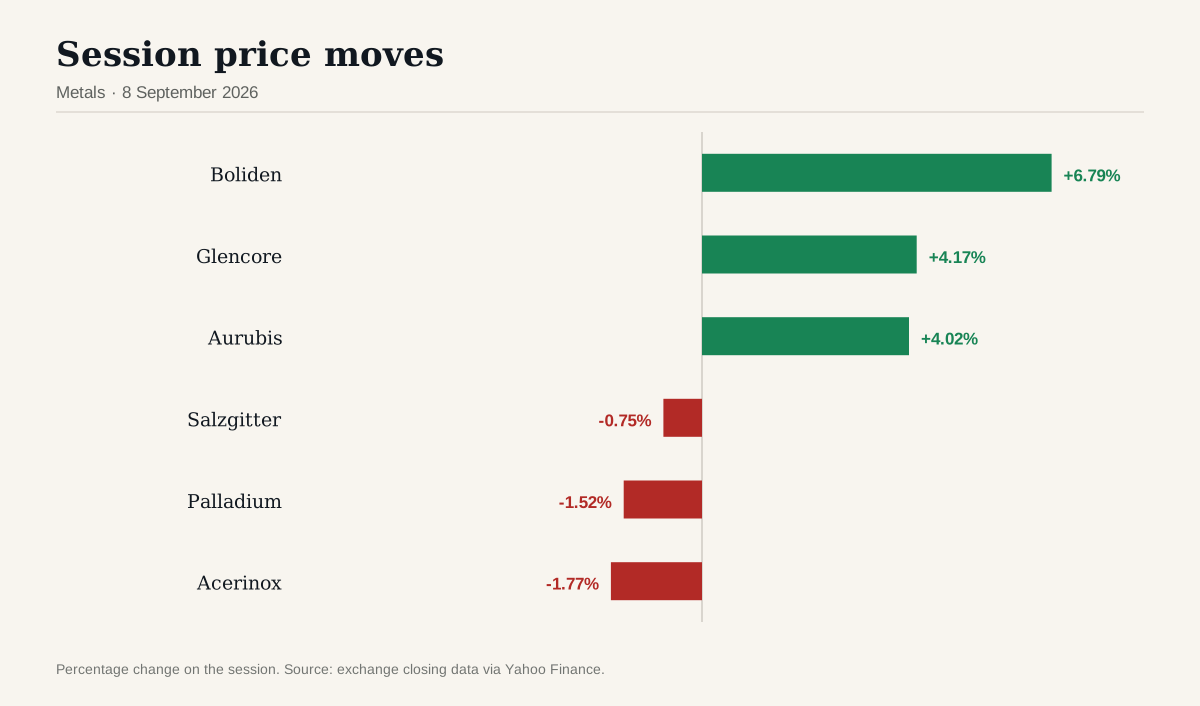
European mining and smelting shares rallied on Monday as copper futures extended their run to record highs, lifting the margins of copper-exposed producers while palladium continued its retreat from the 2024 peak. The STOXX Europe 600 Basic Resources index outperformed the broader market after the US dollar index slipped 0.29 per cent to 98.869, its lowest level in five sessions, removing a headwind for dollar-denominated metal prices.
- Boliden (BOL.ST) +6.79% to SEK 584.8, volume 1.23x 20-day average
- Glencore (GLEN.L) +4.17% to GBp 629, volume 0.74x 20-day average
- Aurubis (NDA.DE) +4.02% to EUR 181, volume 1.01x 20-day average
- Palladium (PA=F) -1.52% to USD 1,369, volume 12.87x 20-day average
- US Dollar Index (DX-Y.NYB) -0.29% to 98.869, 2.9% below 52-week high
Copper strength flows through to smelter economics
| Instrument | Close | Day | 5-day | Volume vs avg |
|---|---|---|---|---|
| Boliden SEK | 584.8 | +6.79% | +3.58% | 1.23x |
| Glencore GBp | 629 | +4.17% | +5.34% | 0.74x |
| Aurubis EUR | 181 | +4.02% | +2.26% | 1.01x |
| Salzgitter EUR | 59.9 | -0.75% | +5.27% | 0.79x |
| Palladium USD | 1,369 | -1.52% | +0.45% | 12.87x |
| Acerinox EUR | 56.58 | -1.77% | -2.82% | 0.44x |
| Source: exchange closing data via Yahoo Finance, session of 2026-09-08. | ||||
The session's dominant move was the advance in copper-linked names. Boliden, which operates the Aitik open-pit copper mine in northern Sweden and the Rönnskär and Harjavalta smelters, rose 6.79 per cent to SEK 584.8 on volume 1.23 times its 20-day average. The stock has gained 12.38 per cent over the past month but remains 19.6 per cent below its 52-week high of SEK 727.8, a level last seen in the first quarter of 2025 when copper briefly traded above USD 11,000 a tonne.
Aurubis, Europe's largest copper smelter and a key supplier of copper cathodes to the German automotive and electrical equipment sectors, added 4.02 per cent to EUR 181. The Hamburg-based company processes roughly 1.2 million tonnes of copper concentrate annually, and its treatment and refining charges, the fees smelters charge miners to process concentrate, have been under pressure from tight concentrate supply. Higher copper prices typically widen the spread between concentrate purchase prices and cathode sales, improving Aurubis's processing margin. The stock trades 19.6 per cent below its 52-week high of EUR 225.2.
Glencore, the Swiss-listed but London-traded diversified miner with significant copper production from Chile, Peru and the Democratic Republic of Congo, rose 4.17 per cent to GBp 629. The company's marketing division also benefits from wider copper spreads. Volume was light at 0.74 times the 20-day average, suggesting the move was driven more by index rebalancing and sector momentum than by new fundamental information. Two headlines accompanied the move: a report that Rio Tinto is to take over Queensland's Aurukun Bauxite Project, and a generic financial media story headlined "Copper Prices Hit Record High. These Stocks Are Jumping." Neither announcement is specific to Glencore's operations.
Palladium slides on exceptional volume; platinum group exposure diverges
Palladium futures fell 1.52 per cent to USD 1,369 an ounce on volume nearly 13 times the 20-day average, the highest relative volume in the entire dataset. The metal is now 36.9 per cent below its 52-week high of USD 2,169.9, reached in May 2024 when Russian supply concerns peaked. The decline has accelerated as automotive demand forecasts have been revised lower: battery-electric vehicles use no palladium, and hybrid vehicles use significantly less than traditional internal-combustion models. European autocatalyst fabricators such as Johnson Matthey and Umicore, neither of which traded in today's universe, have been restructuring their pgm refining capacity in response.
A headline noted that Power Metallic Mines advanced its Nisk Project with an updated mineral resource. The Canadian explorer's nickel-copper-PGE project in Quebec is at an early stage and does not materially affect near-term palladium supply.
Steel and stainless producers lag despite dollar weakness
Acerinox, the Spanish stainless steel producer with mills in Spain, the United States, South Africa and Malaysia, fell 1.77 per cent to EUR 56.58 on volume just 0.44 times its 20-day average. The stock is 18.9 per cent below its 52-week high of EUR 69.76. Stainless steel prices have been pressured by high nickel inventories on the LME and weak demand from the European white goods and construction sectors. Acerinox's exposure to nickel, which has not shared copper's rally, limits the benefit from a weaker dollar.
Salzgitter, the German integrated steelmaker, slipped 0.75 per cent to EUR 59.9 despite a 14.10 per cent gain over the past month. The stock is 11.4 per cent below its 52-week high of EUR 67.6. Salzgitter's transformation plan, which includes the SALCOS low-carbon steel programme backed by German state aid, has driven the recent outperformance, but today's move suggests profit-taking after the rapid advance. Volume was 0.79 times the 20-day average.
Dollar index below 99 removes a broad commodity headwind
The US dollar index closed at 98.869, down 0.29 per cent on the day and 0.73 per cent over the past month. It sits 2.9 per cent below its 52-week high of 101.8. A weaker dollar typically supports dollar-denominated commodity prices by making them cheaper for holders of other currencies. For European industry, the transmission is mixed: lower dollar metal prices reduce raw material costs in euro terms, but a weaker dollar also reduces the euro-denominated revenue of European exporters selling into dollar markets.
For copper-intensive sectors, power grid investment, renewable energy cabling, electric vehicle charging infrastructure, the net effect of higher copper prices and a slightly weaker dollar is an increase in euro-denominated input costs. European cable manufacturers such as Prysmian and Nexans, and electrical equipment groups such as Schneider Electric and Legrand, will see higher bill-of-materials costs unless they have hedged. Construction firms bidding on long-duration infrastructure projects face margin pressure if copper price escalation clauses are absent.
Automotive supply chain watches pgm divergence
The palladium decline, if sustained, reduces the cost of three-way catalysts for petrol and hybrid vehicles. European carmakers, Volkswagen, Stellantis, Renault, BMW and Mercedes-Benz, source catalysts from a concentrated supplier base. Lower pgm costs feed through to component pricing with a lag of one to two quarters, depending on contract structures. However, the platinum price, which is not in today's dataset, has been more stable, and the platinum-palladium spread remains wide, keeping the incentive for thrifting and substitution active.
Volume signals suggest conviction in copper, capitulation in palladium
The volume profile reinforces the divergence. Boliden and Aurubis traded above their 20-day averages, indicating institutional participation in the copper rally. Glencore's below-average volume suggests the move was more passive. In contrast, palladium's 12.87x volume spike points to forced liquidation or systematic trend-following strategies exiting long positions. Such volume extremes often mark short-term turning points, though the 36.9 per cent distance from the 52-week high argues against a quick recovery.
Next data point: LME copper warehouse stocks are due for release at 12:00 BST tomorrow, followed by the International Copper Study Group's monthly market balance at 14:00 BST on Wednesday.
Boliden · three-month price
Chart: TradingView. Live prices may differ from the closing figures quoted above.