
palladium jumps nearly 7 % as dollar eases, silver and platinum also rise
Palladium surged 6.86 % to US$1,439, while silver and platinum each gained over 4 % on 3 September 2026. European miners Eramet, Rio Tinto and Aurubis moved little, leaving the broader metals universe largely in the green.
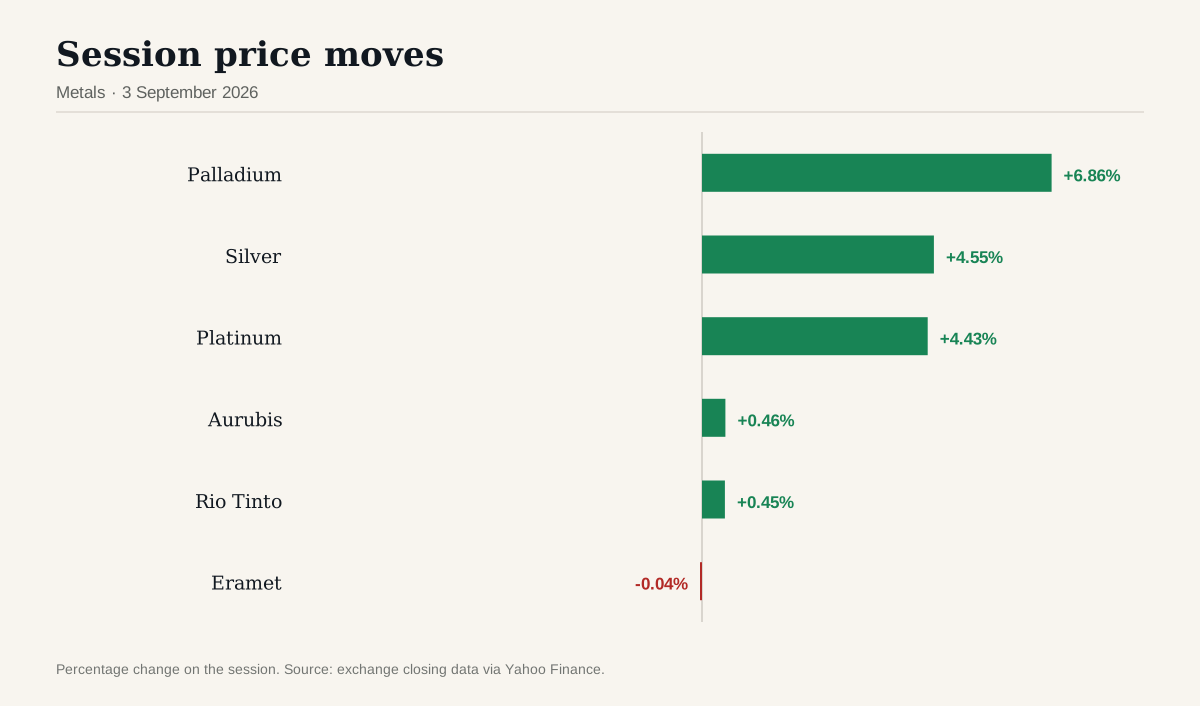
On 3 September 2026 the most pronounced move in the metals universe was a 6.86 % rise in Palladium futures, which closed at US$1,439. The price advance came as the US dollar index slipped 0.67 % to 98.893, a factor that typically supports dollar‑denominated commodities. Silver and Platinum also posted double‑digit gains, up 4.55 % and 4.43 % respectively, while the three listed producers in the sample, Eramet, Rio Tinto and Aurubis, recorded modest changes.
- Palladium closed at US$1,439, up 6.86 % on the day
- Silver closed at US$67.67, up 4.55 % on the day
- Platinum closed at US$1,837.8, up 4.43 % on the day
- US dollar index closed at 98.893, down 0.67 % on the day
- Eramet shares closed at €44.86, down 0.04 % on the day
Precious metal price moves
| Instrument | Close | Day | 5-day | Volume vs avg |
|---|---|---|---|---|
| Palladium USD | 1,439 | +6.86% | +7.58% | 11.72x |
| Silver USD | 67.67 | +4.55% | -2.53% | 23.38x |
| Platinum USD | 1,837.8 | +4.43% | -0.41% | 284.82x |
| Aurubis EUR | 174 | +0.46% | -2.52% | 0.7x |
| Rio Tinto GBp | 7,611 | +0.45% | -1.44% | 0.57x |
| Eramet EUR | 44.86 | -0.04% | -0.58% | 0.68x |
| Source: exchange closing data via Yahoo Finance, session of 2026-09-03. | ||||
The palladium rally was the strongest single‑day move among the three precious metals tracked. The contract traded at a volume 11.72 times its 20‑day average, indicating heightened market activity. At US$1,439 the price sits 33.7 % below its 52‑week high of US$2,169.9, leaving considerable upside potential if the upward trend continues.
Silver, which closed at US$67.67, rose 4.55 % on the day and recorded a trading volume 23.38 times the 20‑day average. The metal remains 44.2 % below its 52‑week high of US$121.3. The surge followed reports of short‑lived airstrikes, a factor that can temporarily tighten physical supply and lift spot prices.
Platinum finished the session at US$1,837.8, a 4.43 % increase. Volume was extraordinary, 284.82 times the 20‑day average, suggesting that market participants were eager to adjust positions. The price is 35.6 % below its 52‑week high of US$2,852.4.
All three metals are priced in US dollars, so the 0.67 % weakening of the dollar index contributed to the price gains. A weaker dollar reduces the effective cost of imported metals for European manufacturers, but it also raises the euro‑denominated price of the metals themselves, a factor that can compress margins for firms that use them as inputs.
European listed metal producers
Among the fourteen companies that traded, thirteen rose and one fell. The sole decliner was Eramet, whose shares slipped 0.04 % to €44.86. The move was marginal and the stock traded at 0.68 times its 20‑day average volume, indicating limited investor interest on the day. Eramet's price remains 49.1 % below its 52‑week high of €88.2, suggesting that the company is still far from the valuation it achieved at the peak of the cycle.
Rio Tinto posted a modest gain of 0.45 % to close at GBp 7,611. The volume was 0.57 times the 20‑day average, again pointing to a quiet trading day. The share price is 16.5 % below its 52‑week high of GBp 9,117, a position that reflects a market that has not yet fully recovered from the broader commodity price corrections of the previous year.
Aurubis, the German copper producer, edged up 0.46 % to €174. Trading volume was 0.7 times the 20‑day average. The stock sits 22.7 % below its 52‑week high of €225.2, indicating that the company's valuation remains constrained by the recent weakness in copper and broader industrial metal markets.
None of the three producers announced any corporate news that day. Their price movements therefore appear to be driven primarily by the broader metal price environment and the shift in the dollar index, rather than by company‑specific events.
Implications for European industrial costs
Palladium is a key input for automotive catalytic converters. A 6.86 % rise in the spot price translates into higher input costs for European car manufacturers that source the metal for emission‑control systems. While the price is still 33.7 % below its 52‑week high, the upward momentum could tighten margins for OEMs that have limited hedging capacity.
Silver is widely used in electronics, photovoltaics and high‑tech equipment. The 4.55 % increase adds to the cost base for European firms that rely on silver for conductive inks, solar panels and specialty alloys. The metal's price remains well under its 52‑week peak, but the recent surge may prompt buyers to reassess procurement strategies, especially if the price spike is linked to short‑term supply disruptions.
Platinum, like palladium, is a core component of catalytic converters and also finds use in jewellery and certain industrial applications. The 4.43 % rise adds pressure on automotive suppliers, while the unusually high trading volume suggests that market participants are actively rebalancing exposure, a sign that the price move is not merely a statistical blip.
The weakening of the dollar index by 0.67 % reduces the euro‑denominated cost of importing these metals, partially offsetting the headline price gains. For a European manufacturer that purchases palladium at US$1,439, the euro price would be lower than if the dollar had remained at its previous level of 99.56, all else equal. However, the net effect on cost depends on the timing of purchases and the extent of any currency hedging.
For the listed producers, the modest share price moves suggest that investors are not yet pricing in a dramatic shift in margins. Eramet's near‑flat performance, despite a slight dip, indicates that the market does not see an immediate impact from the palladium rally, perhaps because Eramet's exposure to palladium is limited. Rio Tinto's small gain reflects its diversified portfolio, where a rise in precious metal prices is only one of many factors influencing earnings. Aurubis, focused on copper, is largely insulated from the palladium, silver and platinum moves, which explains its muted reaction.
The broader metals universe, with 13 out of 14 stocks in the green, signals a market that is broadly supportive of higher metal prices. This sentiment could translate into tighter input cost environments for European manufacturers that depend on these commodities, unless they can lock in prices through forward contracts or other hedging mechanisms.
Looking ahead
The next trading session will reveal whether the palladium, silver and platinum advances sustain momentum or revert as the dollar index stabilises. Investors will watch the 52‑week ranges, 33.7 % below the high for palladium, 44.2 % below for silver and 35.6 % below for platinum, for signs of a breakout toward those peaks.
For European industry, the key dates are the upcoming earnings releases of the listed producers and the quarterly procurement cycles of automotive and electronics firms, which will determine how the current price environment translates into real‑world cost pressures.
On 3 September 2026 the US dollar index closed at 98.893, palladium settled at US$1,439, silver at US$67.67 and platinum at US$1,837.8, while Eramet, Rio Tinto and Aurubis ended the day at €44.86, GBp 7,611 and €174 respectively.
Eramet · three-month price
Chart: TradingView. Live prices may differ from the closing figures quoted above.