
German and French markets tumble as DAX and CAC 40 fall, Kering leads losses
The DAX slipped 1.66 per cent to 25 576.45 and the CAC 40 fell 1.94 per cent to 8 156.67. Only six of the 78 listed German and French stocks rose while 72 declined, underscoring a broadly negative session.
The DAX closed at 25 576.45, down 1.66 per cent on the day, while the CAC 40 finished at 8 156.67, off 1.94 per cent. Across the combined German and French universe, six names rose and seventy‑two fell, a breadth ratio that highlights the depth of the sell‑off.
- DAX close 25 576.45 EUR, down 1.66 %
- CAC 40 close 8 156.67 EUR, down 1.94 %
- Market breadth 6 up, 72 down
- Euro Stoxx 50 down 1.58 % to 6 311.56 EUR
- Both indices traded at zero times their 20‑day average volume
Top risers
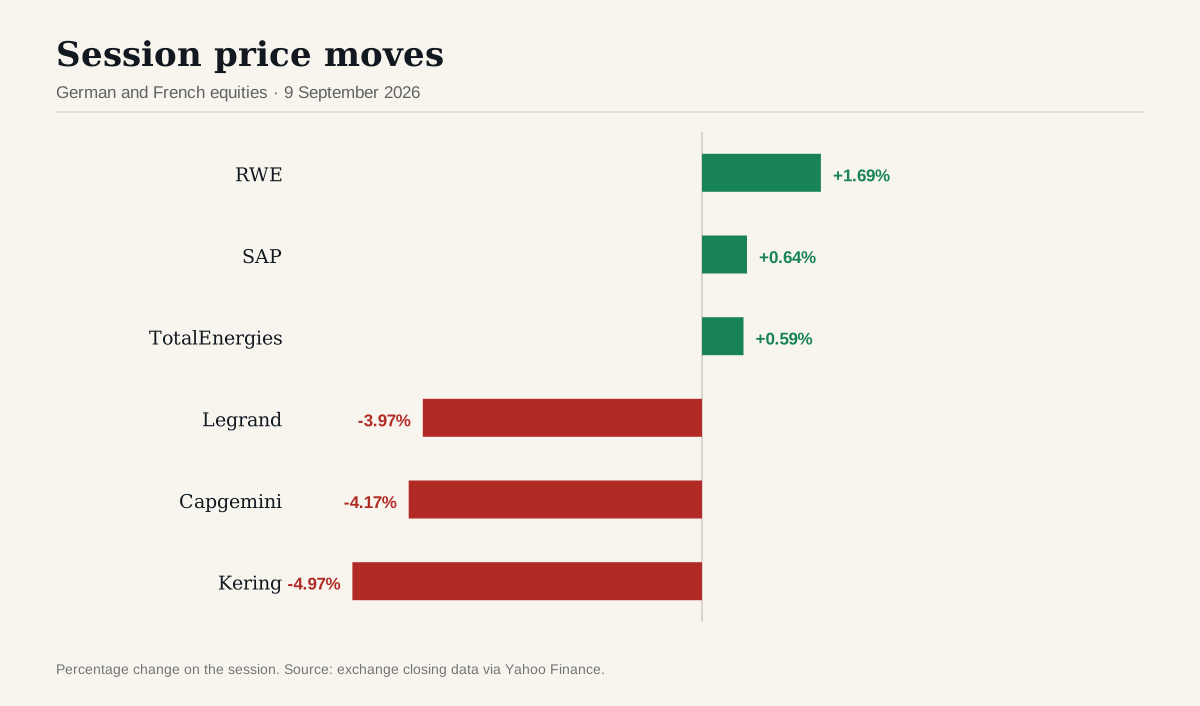
| Instrument | Close | Day | 5-day | Volume vs avg |
|---|---|---|---|---|
| RWE EUR | 60.26 | +1.69% | +2.87% | 1.38x |
| SAP EUR | 182.86 | +0.64% | -0.76% | 1.1x |
| TotalEnergies EUR | 78.21 | +0.59% | +0.77% | 1.28x |
| Legrand EUR | 140.35 | -3.97% | +4.43% | 1.11x |
| Capgemini EUR | 101.15 | -4.17% | -5.11% | 1.66x |
| Kering EUR | 232.25 | -4.97% | -6.05% | 1.41x |
| Source: exchange closing data via Yahoo Finance, session of 2026-09-09. | ||||
RWE (RWE.DE, XETRA)
RWE, the German electricity generator, ended the session at 60.26 EUR, up 1.69 % from the previous close of 59.26 EUR. The five‑day gain of 2.87 % and the one‑month rise of 6.65 % show that the stock has been climbing faster than the broader market, which has been falling. Trading volume was 1.38 times the 20‑day average, indicating that the move was supported by a higher than usual level of activity. The price sits 2.8 % below the 52‑week high of 62 EUR, leaving limited upside before the upper bound is reached.
SAP (SAP.DE, XETRA)
SAP, the German enterprise‑software group, closed at 182.86 EUR, a modest increase of 0.64 % on the day. The five‑day change is negative at, 0.76 % while the one‑month performance is +1.99 %, suggesting a short‑term pull‑back within a broader uptrend. Volume was 1.1 times the 20‑day average, modestly above the norm. The share price is 25.1 % below the 52‑week high of 244.3 EUR, indicating ample room for further movement. Reported items mention a "once‑in‑a‑lifetime opportunity" with AI and a series of partnership announcements, but the data does not link these directly to the price change.
TotalEnergies (TTE.PA, Paris)
TotalEnergies, the French integrated energy group, finished at 78.21 EUR, up 0.59 % from 77.75 EUR. The five‑day gain of 0.77 % and the one‑month rise of 3.53 % contrast with the market‑wide decline. Volume was 1.28 times the 20‑day average, again pointing to a relatively active trade. The price remains 3.8 % below the 52‑week high of 81.34 EUR. The reported news items refer to oil‑price volatility and a swap involving Mopane and Venus discoveries, but the price move is reported without a causal claim.
Top fallers
Kering (KER.PA, Paris)
Kering, the French luxury‑goods conglomerate, fell to 232.25 EUR from 244.40 EUR, a drop of 4.97 % on the day. The five‑day decline of 6.05 % and the one‑month slide of 18.05 % place the stock well into a downtrend that is far steeper than the market average. Volume was 1.41 times the 20‑day average, suggesting that the sell‑off attracted considerable participation. The share now sits 34.4 % below the 52‑week high of 354.2 EUR, a distance that signals a substantial discount to its recent peak.
Capgemini (CAP.PA, Paris)
Capgemini, the French consulting and technology services firm, closed at 101.15 EUR, down 4.17 % from 105.55 EUR. The five‑day fall of 5.11 % and the one‑month decline of 6.34 % mirror the broader weakness in the sector. Trading volume was 1.66 times the 20‑day average, the highest relative volume among the three fallers, indicating a pronounced sell‑side interest. The price is 33.9 % below the 52‑week high of 153.05 EUR, leaving a large gap to the top of its range.
Legrand (LR.PA, Paris)
Legrand, the French electrical‑equipment specialist, slipped to 140.35 EUR from 146.15 EUR, a decline of 3.97 % on the day. Unlike the other two fallers, Legrand posted a five‑day gain of 4.43 % and a one‑month rise of 1.12 %, indicating that the daily drop may be a short‑term correction within a longer‑term uptrend. Volume was 1.11 times the 20‑day average, modestly above the norm. The share sits 15.9 % below the 52‑week high of 166.95 EUR.
Session overview
The session was characterised by a broad retreat across German and French equities. Both the DAX and the CAC 40 recorded declines of more than one and a half per cent, while the Euro Stoxx 50 fell 1.58 % to 6 311.56 EUR. The breadth figure, six advancers against seventy-two decliners, shows that the sell-off was spread across many sectors.
Volume for the three major indices was recorded at zero times their 20‑day averages, a statistical indication that trading activity was unusually thin. By contrast, the six stocks that moved the most all traded at volumes above the 20‑day average, ranging from 1.1 to 1.66 times. This pattern suggests that while the broader market was quiet, investors concentrated their attention on a limited set of names.
Among the risers, two are energy‑related, RWE and TotalEnergies, and both posted gains that outpaced the market despite the backdrop of heightened oil‑price volatility reported in the news feed. Their price positions remain close to the upper end of their 52‑week ranges, which may limit further upside in the short term.
The software leader SAP managed a small rise on the day but remains well below its 52‑week high, leaving a sizeable margin for future movement. The reported AI opportunity and a series of partnership announcements could be relevant for longer‑term positioning, but the data does not confirm a direct link to the modest price change.
On the downside, the three biggest decliners belong to distinct sectors: luxury goods (Kering), consulting and technology services (Capgemini), and electrical equipment (Legrand). Kering and Capgemini are both trading at roughly one‑third below their 52‑week peaks, a level that may attract value‑oriented investors if the price gap narrows. Legrand, despite the daily fall, shows a longer‑term upward bias, as evidenced by its positive five‑day and one‑month returns and a smaller distance to its 52‑week high.
The lack of a single unifying catalyst across the movers points to an idiosyncratic session. Some of the news items reference Middle‑East tensions and oil‑price swings, but those themes appear only in the commentary attached to TotalEnergies and do not explain the moves in the other stocks. Likewise, the AI narrative surrounding SAP is not reflected in the price action of the other technology names.
Overall, the market breadth and the muted index volumes suggest that investors are exercising caution, perhaps awaiting clearer signals from macro‑economic data or geopolitical developments. The heavy trading in the six most volatile names indicates that capital is being reallocated selectively rather than across the board.
Looking ahead, the next scheduled earnings release for Legrand is set for 2026‑10‑15, a date that could provide fresh information on whether the recent dip is a temporary correction or the start of a longer‑term trend.
RWE · three-month price
Chart: TradingView. Live prices may differ from the closing figures quoted above.